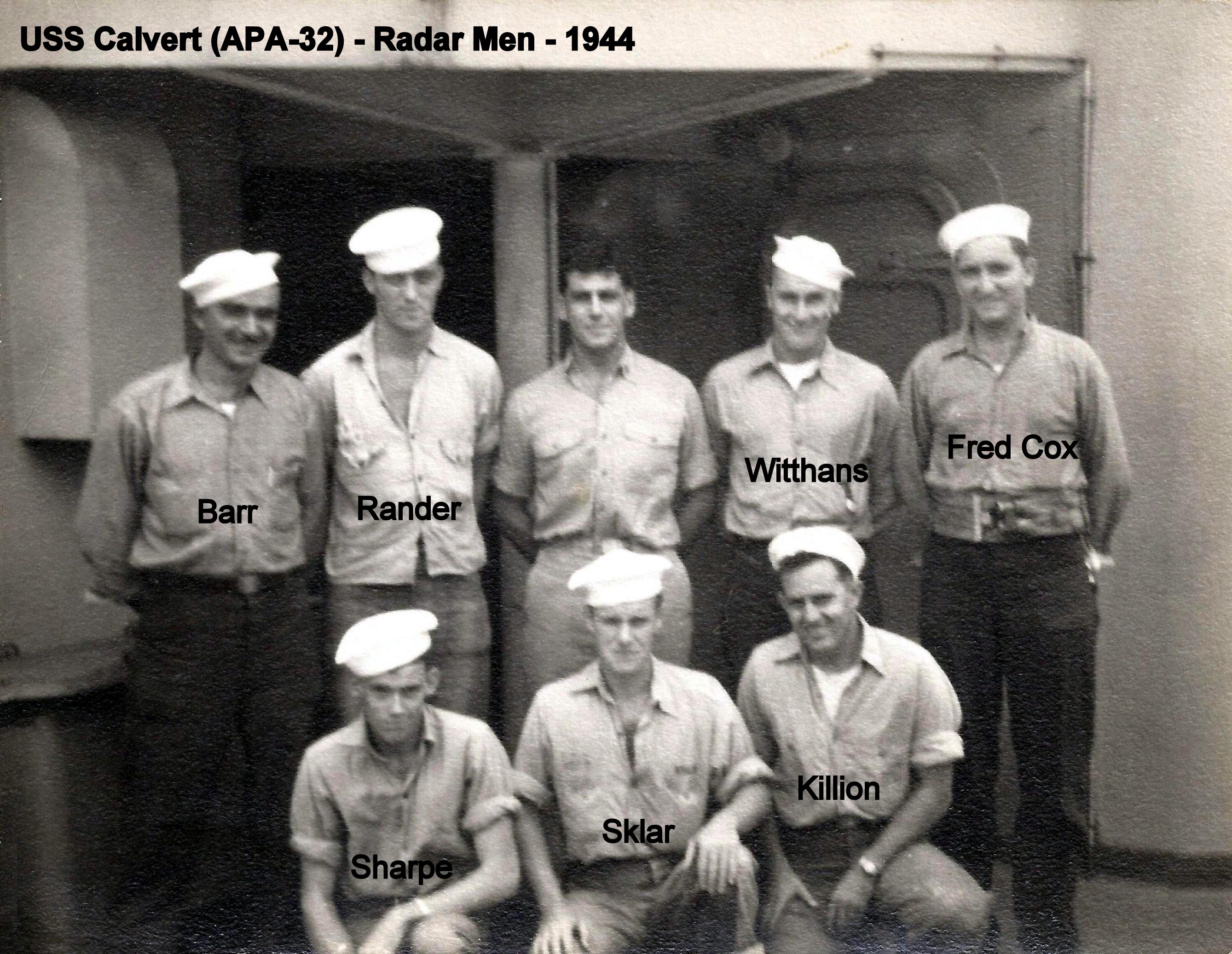
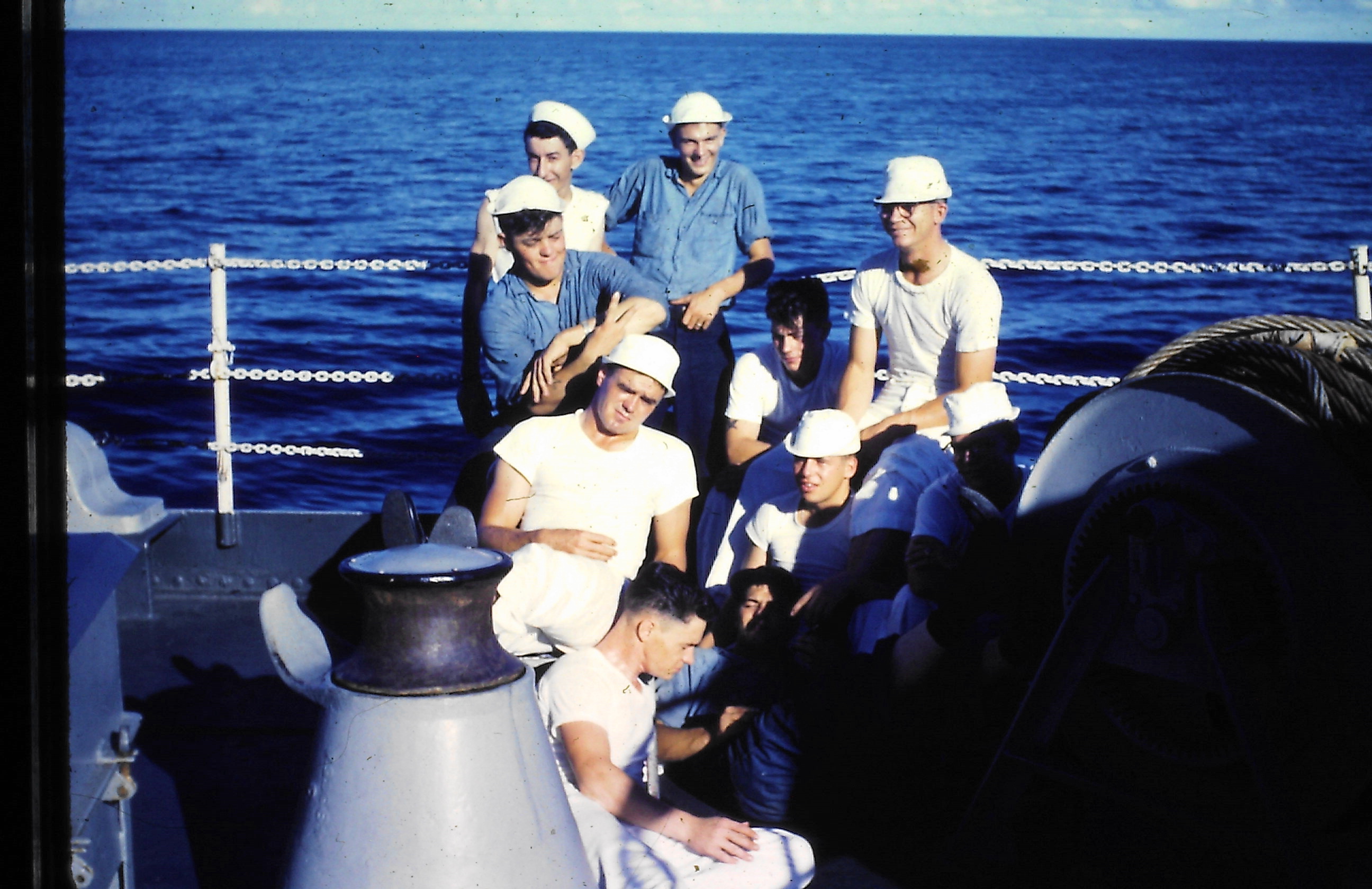
Ronnie Cox’s father, Walter “Fred” Cox (RdM), was a Radarman on the Calvert during WWII. Here is a picture of the Calvert’s radar men from Ronnie’s photograph collection. Annotations are based on the writing on the back of the photograph (also provided by Ronnie). The officer in the middle of the back row was not named. Notice the bright white “Dixie Cup” caps, compared to the grey/blue dyed caps in many of the other WWII-era crew photographs.
Standing rear: Barr | Robert E. Randle, RdM3c | Unknown Officer | Vernon R. Witthans, RdM2c(T) | Fred Cox RdM2c
Kneeling front: Wendell R. Sharpe, RdM3c | Benjamin Sklar, RdM2c(T) | Curits W. Killion, RdM2c
Fred Cox is wearing a life vest around his waist, and it is likely that he was “on duty” on the bridge at the time the picture was taken. Fred served aboard the Calvert from its very first deployment all the way to early August of 1945 when he went on leave. While he was on leave the war ended, and though he had to go back to California to muster-out, he never returned to the Calvert. Fred died in 1967.
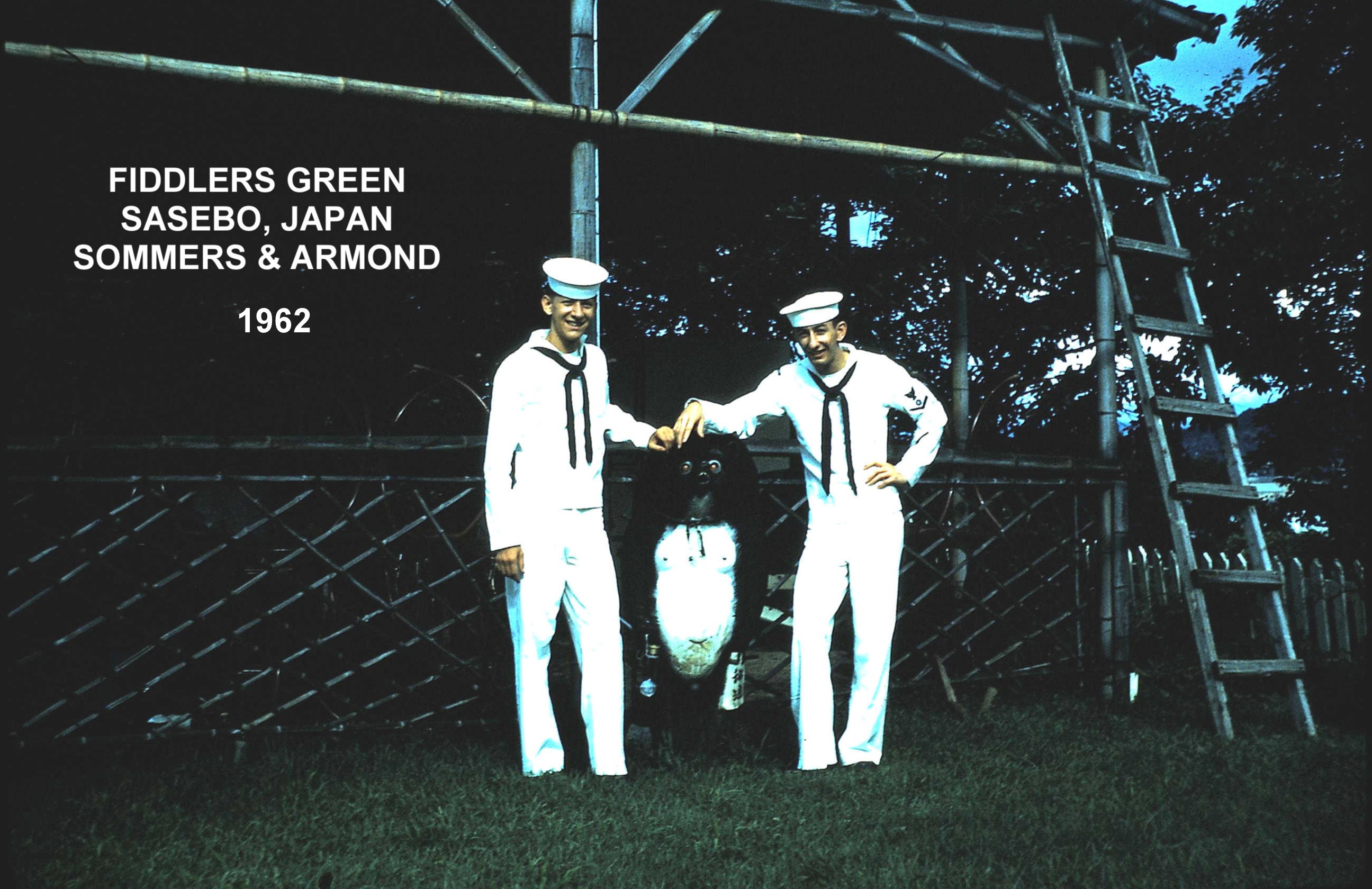
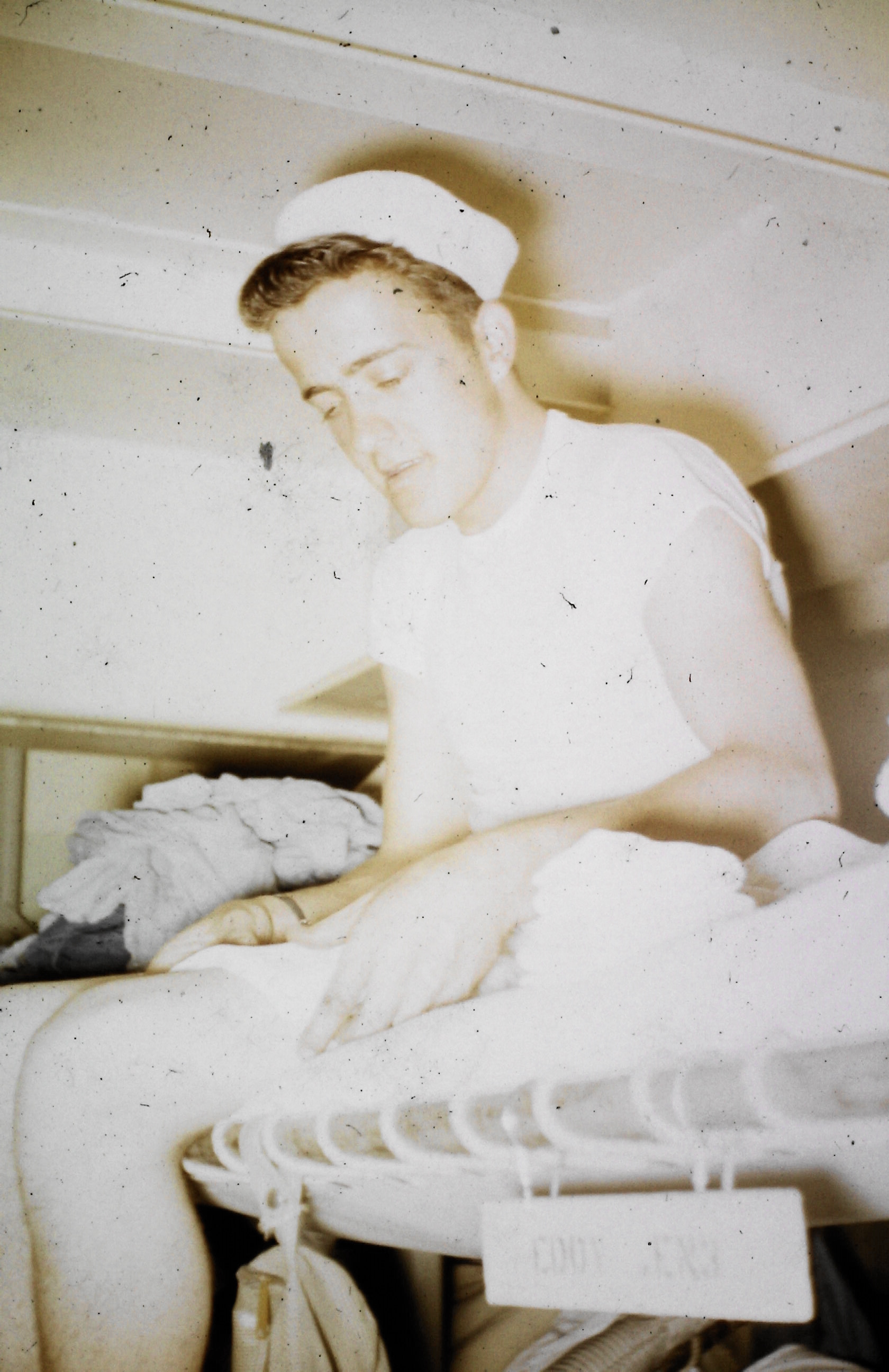
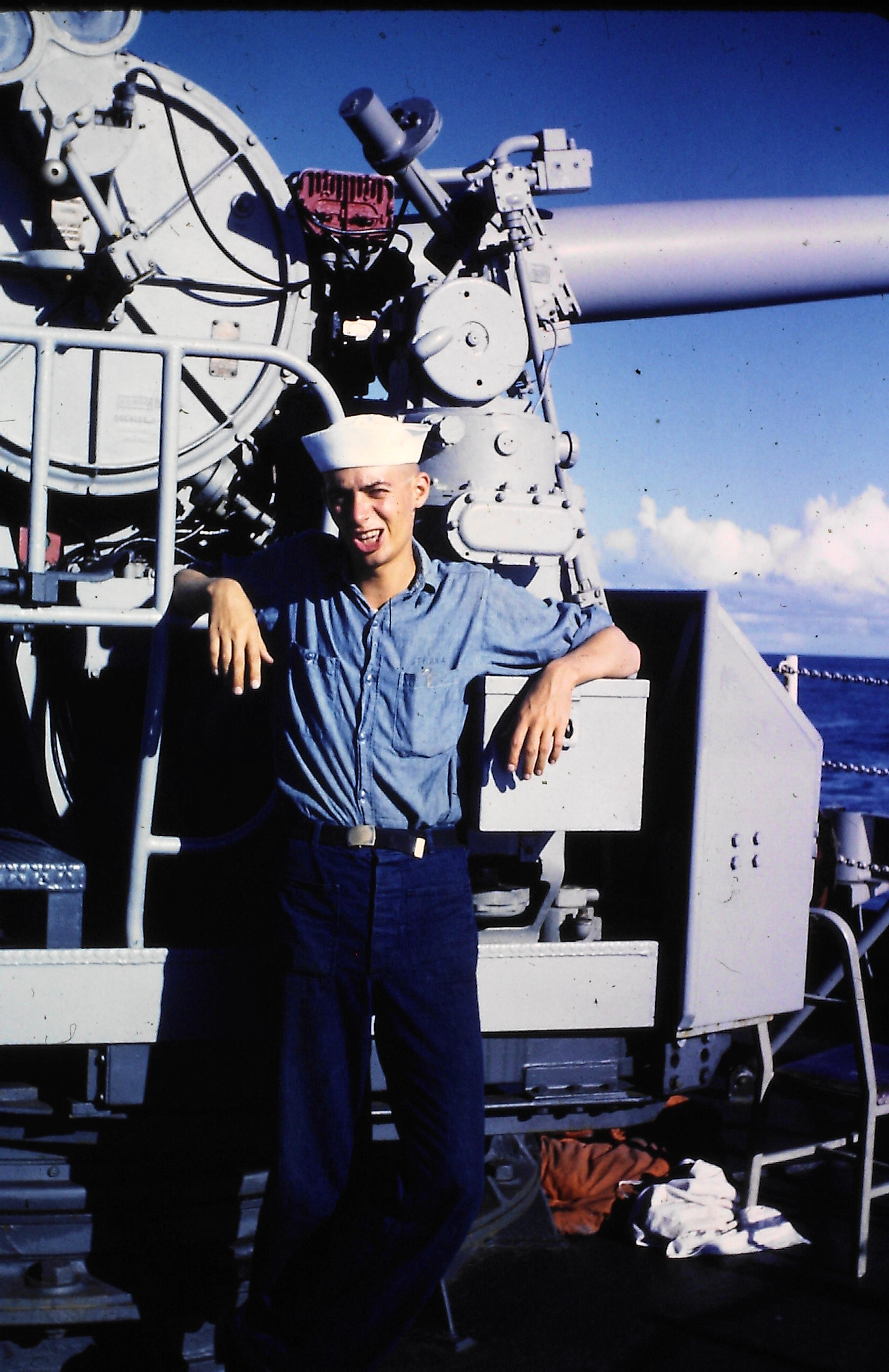
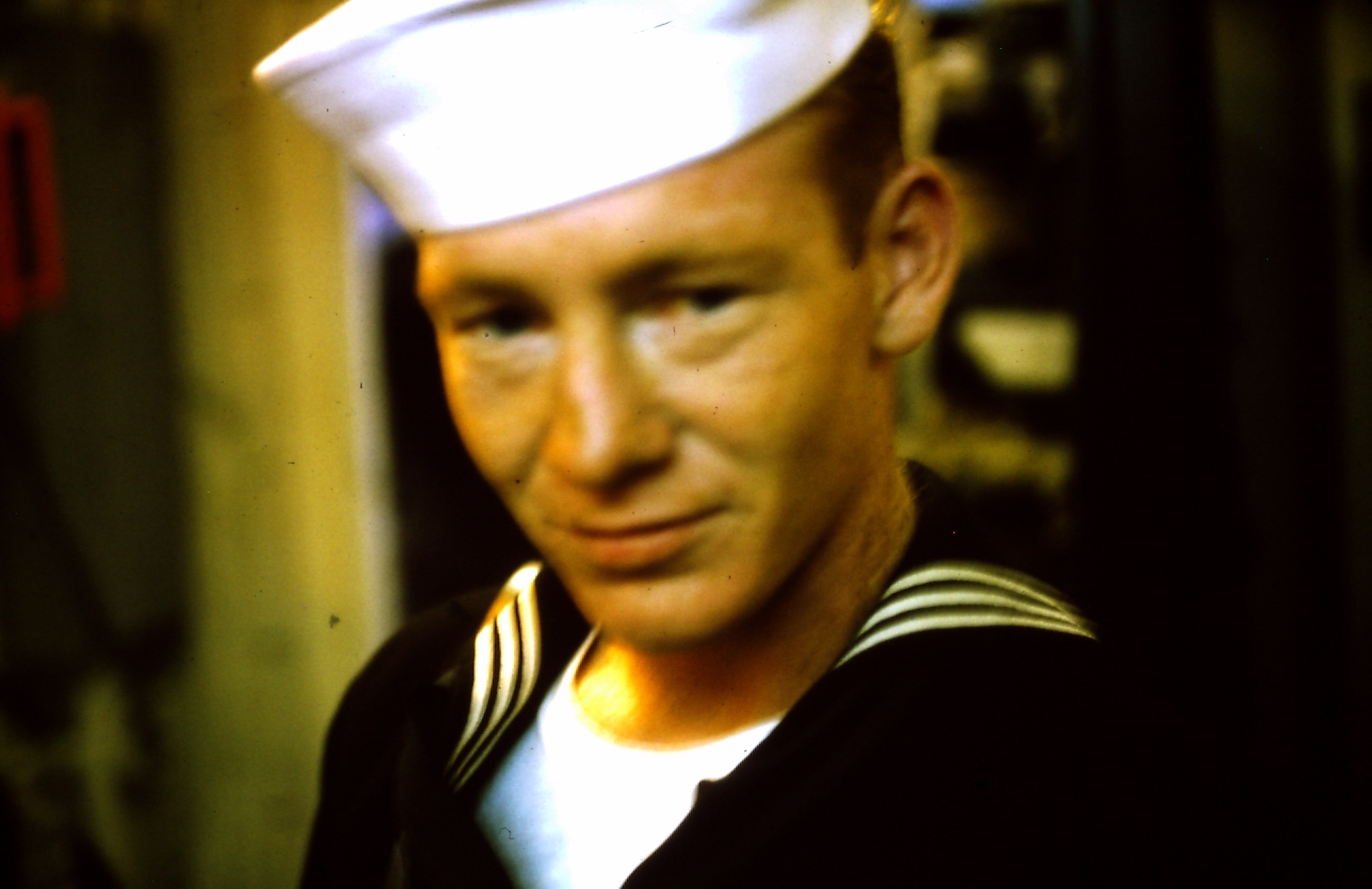
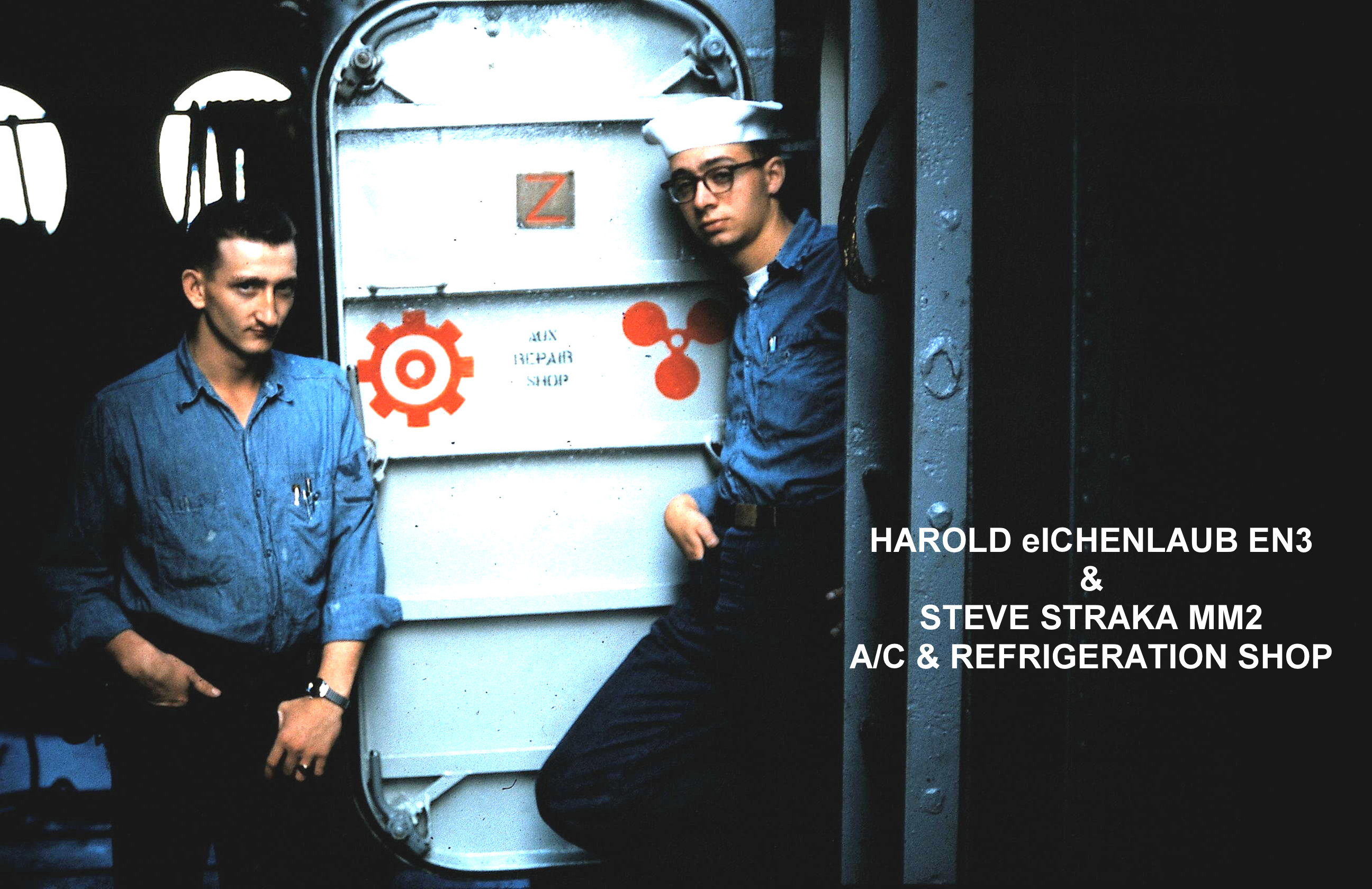
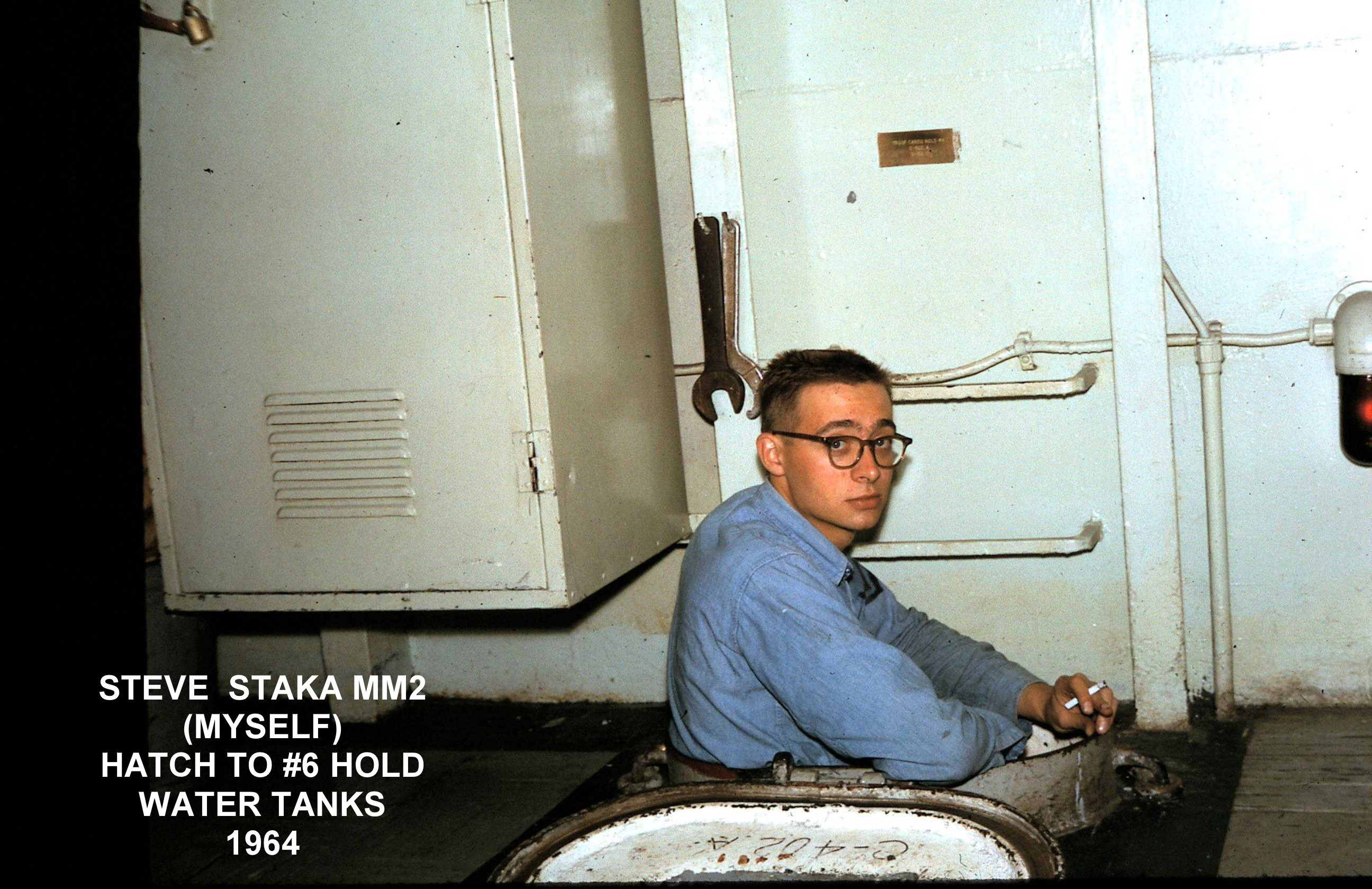
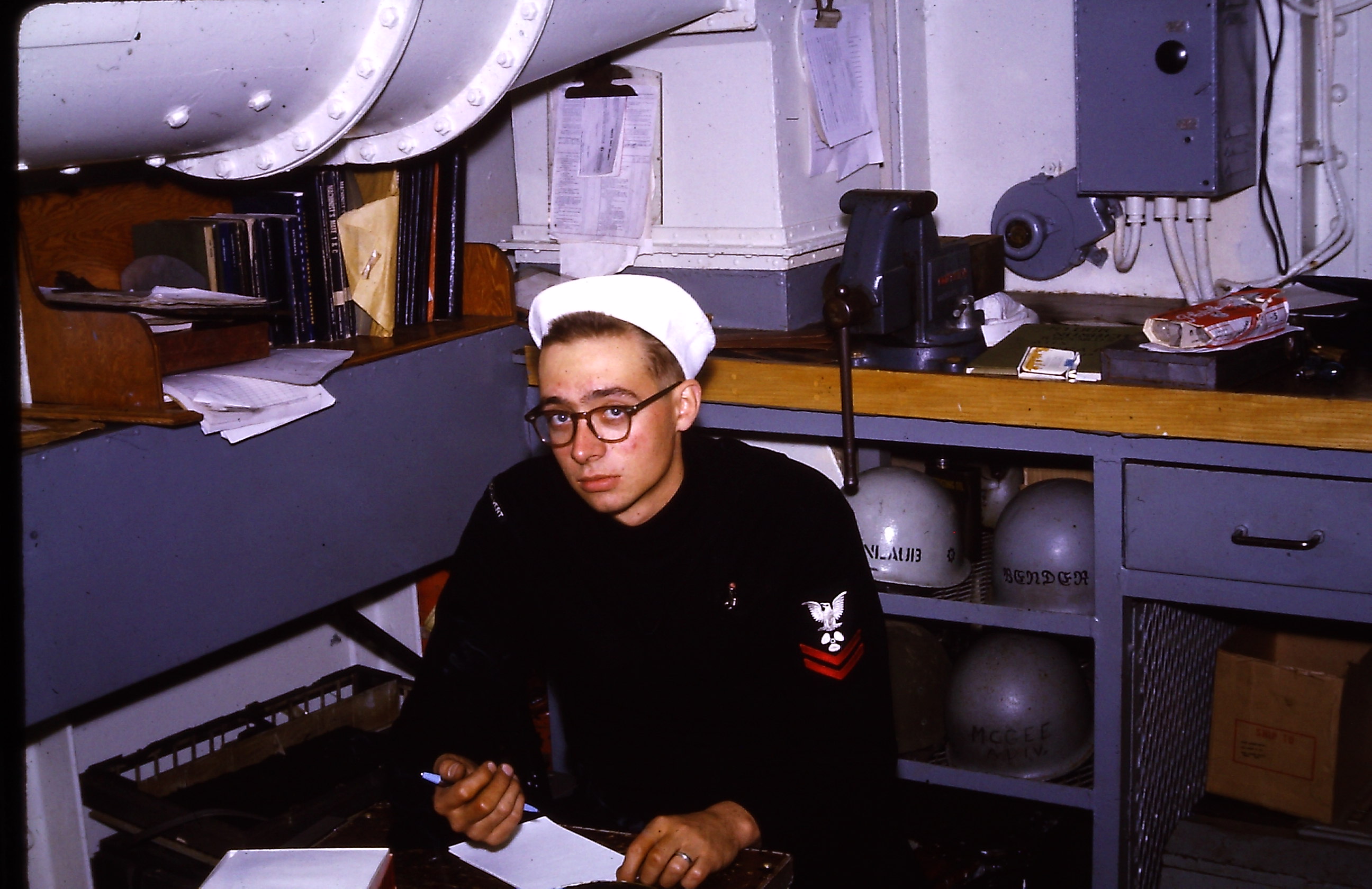
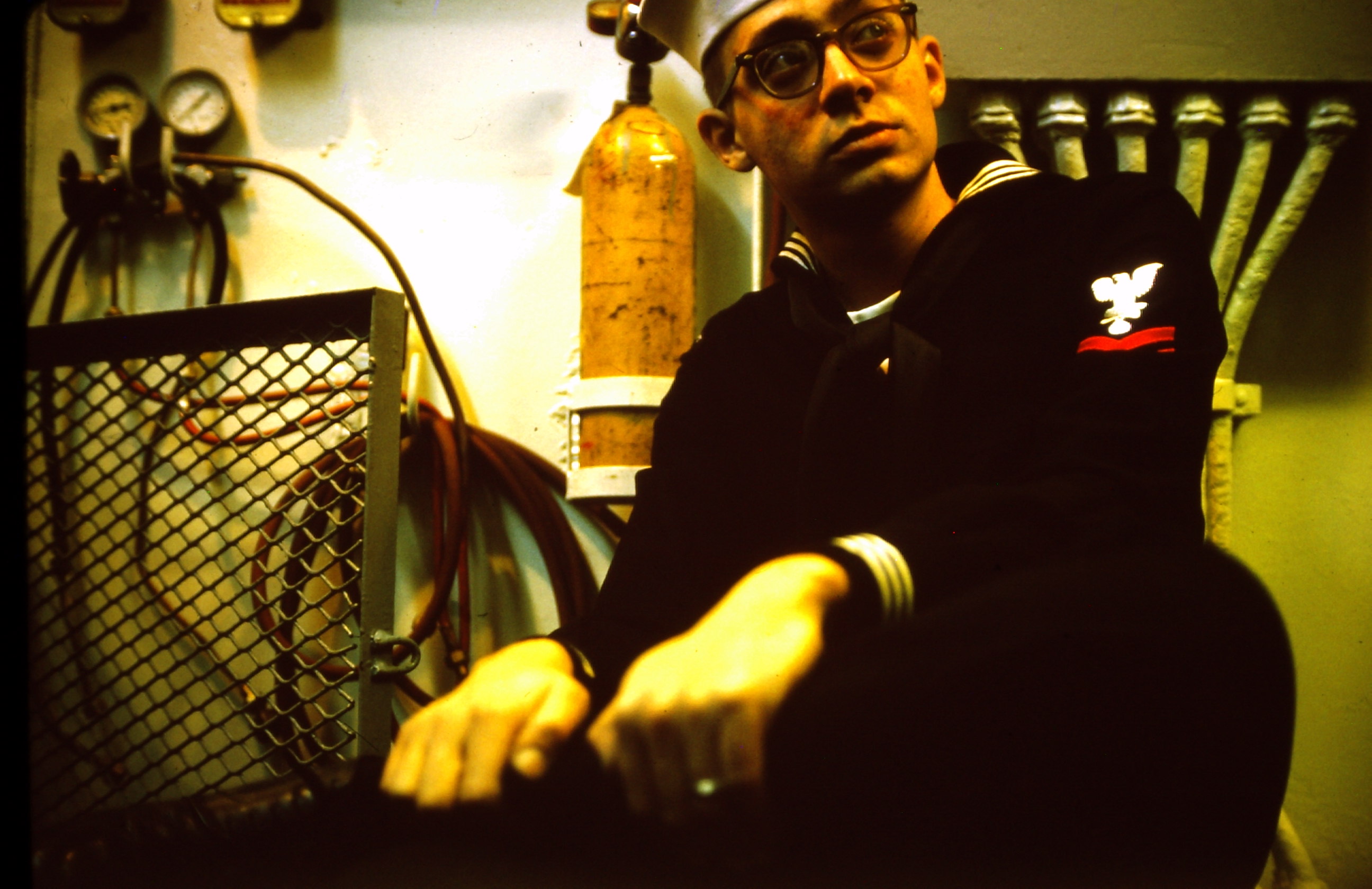
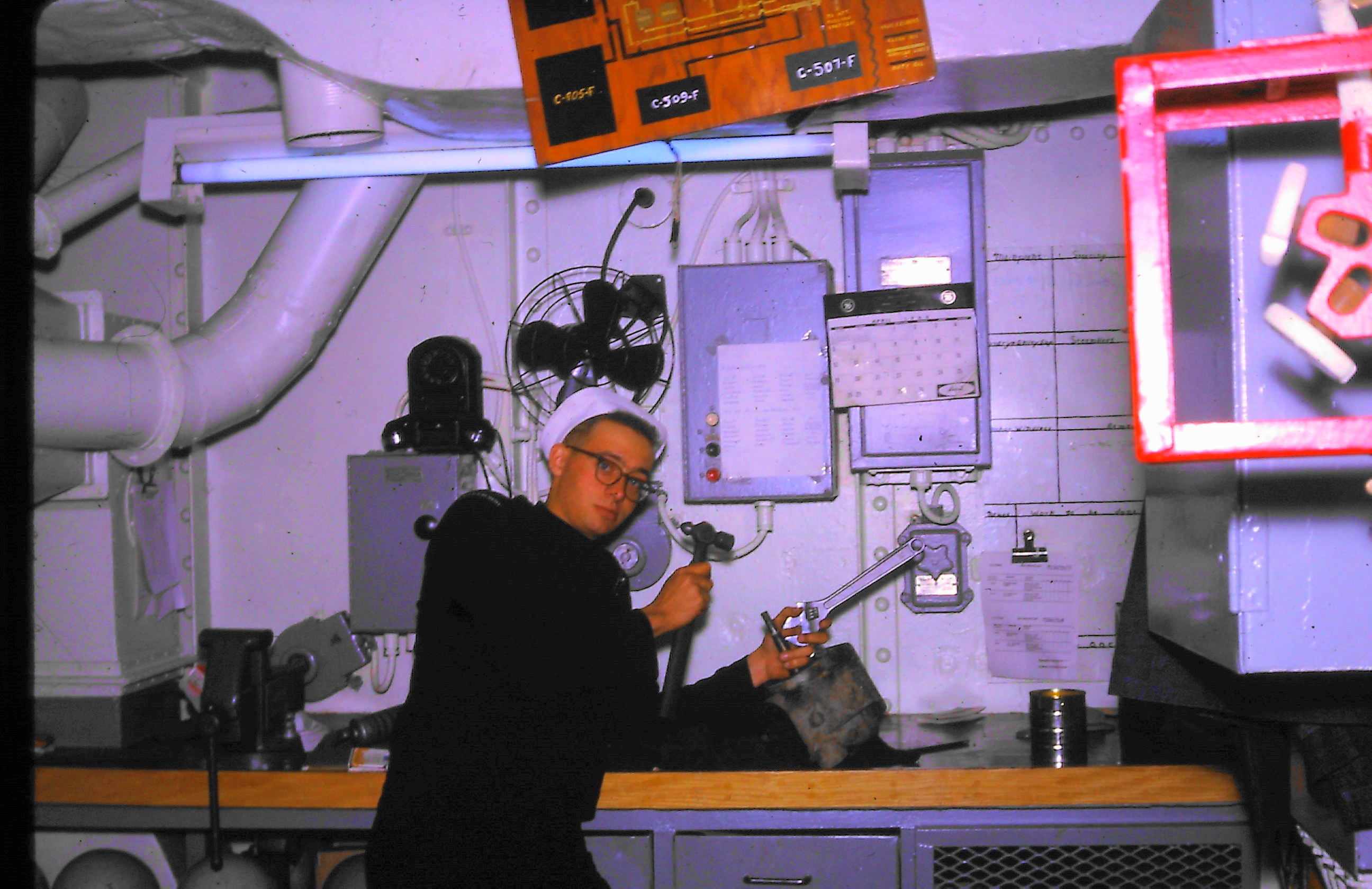
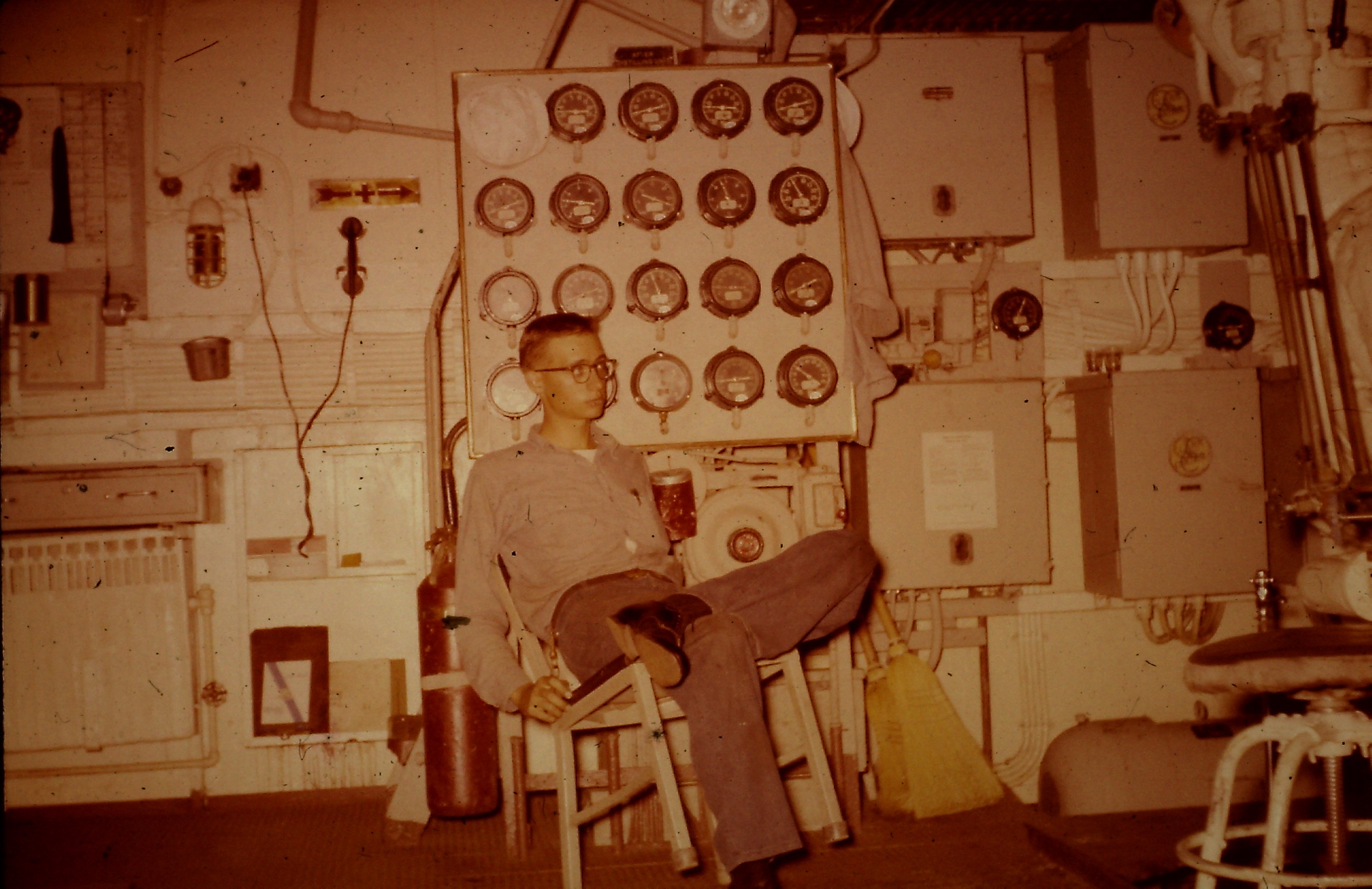
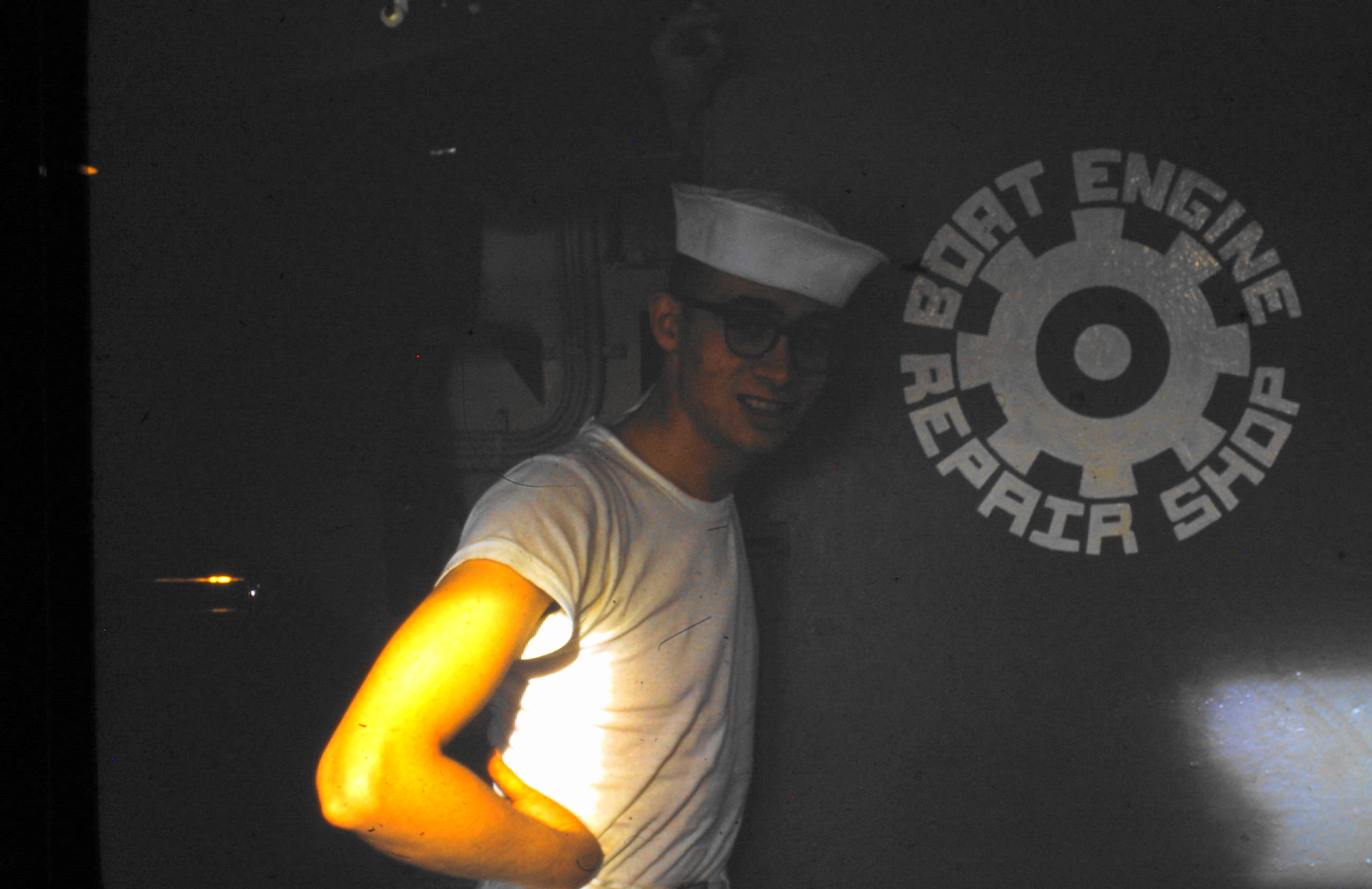
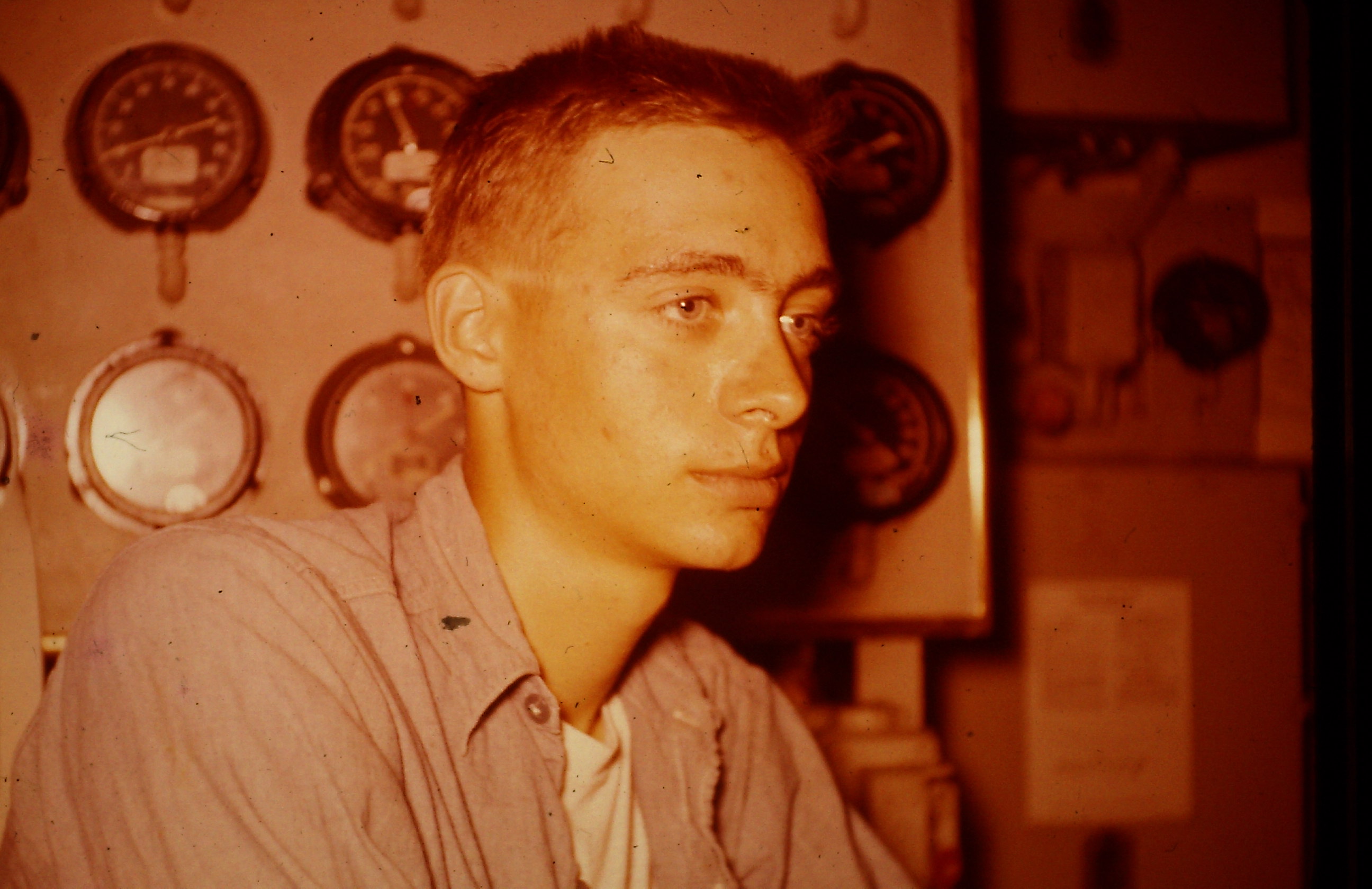
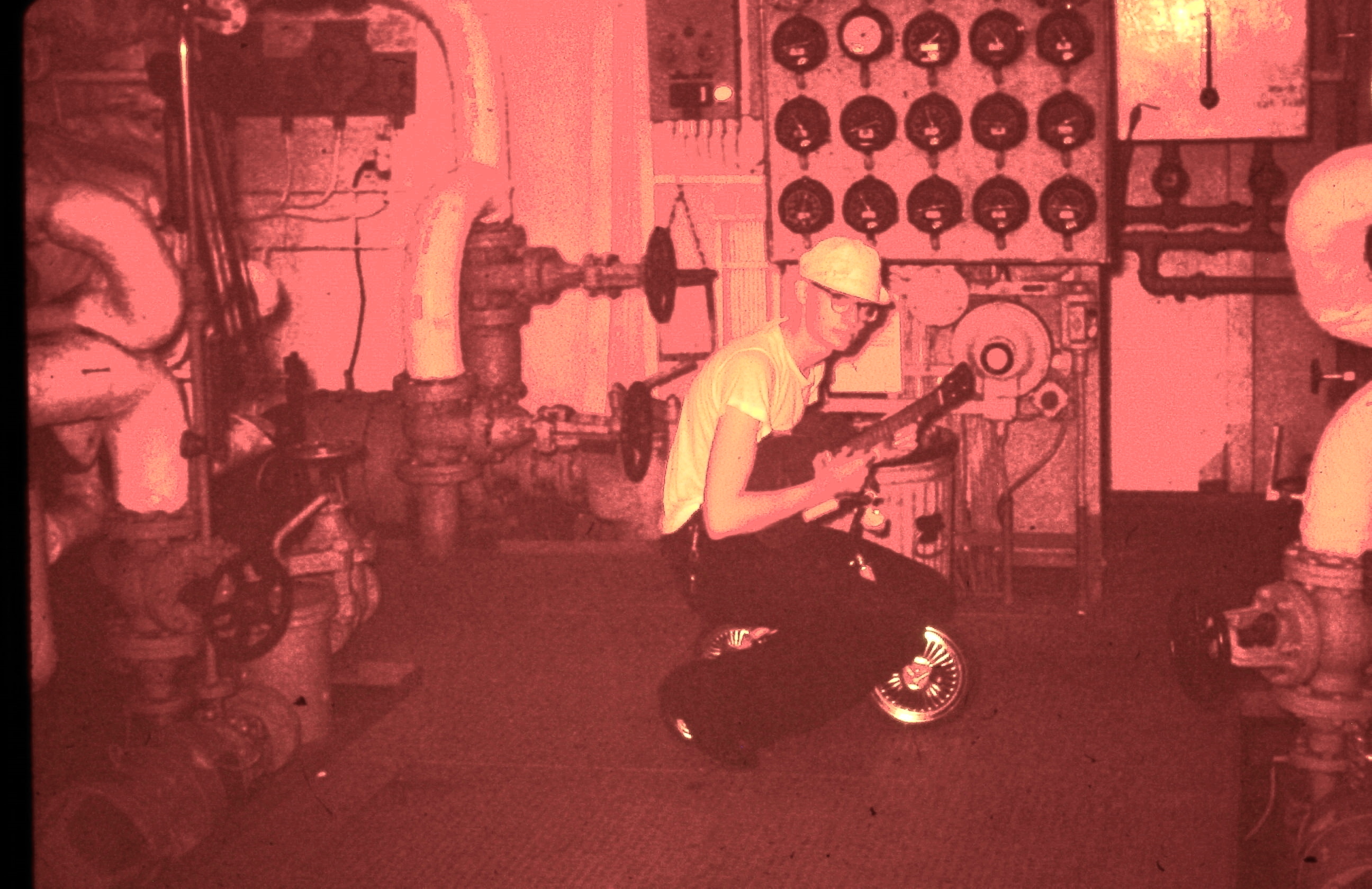
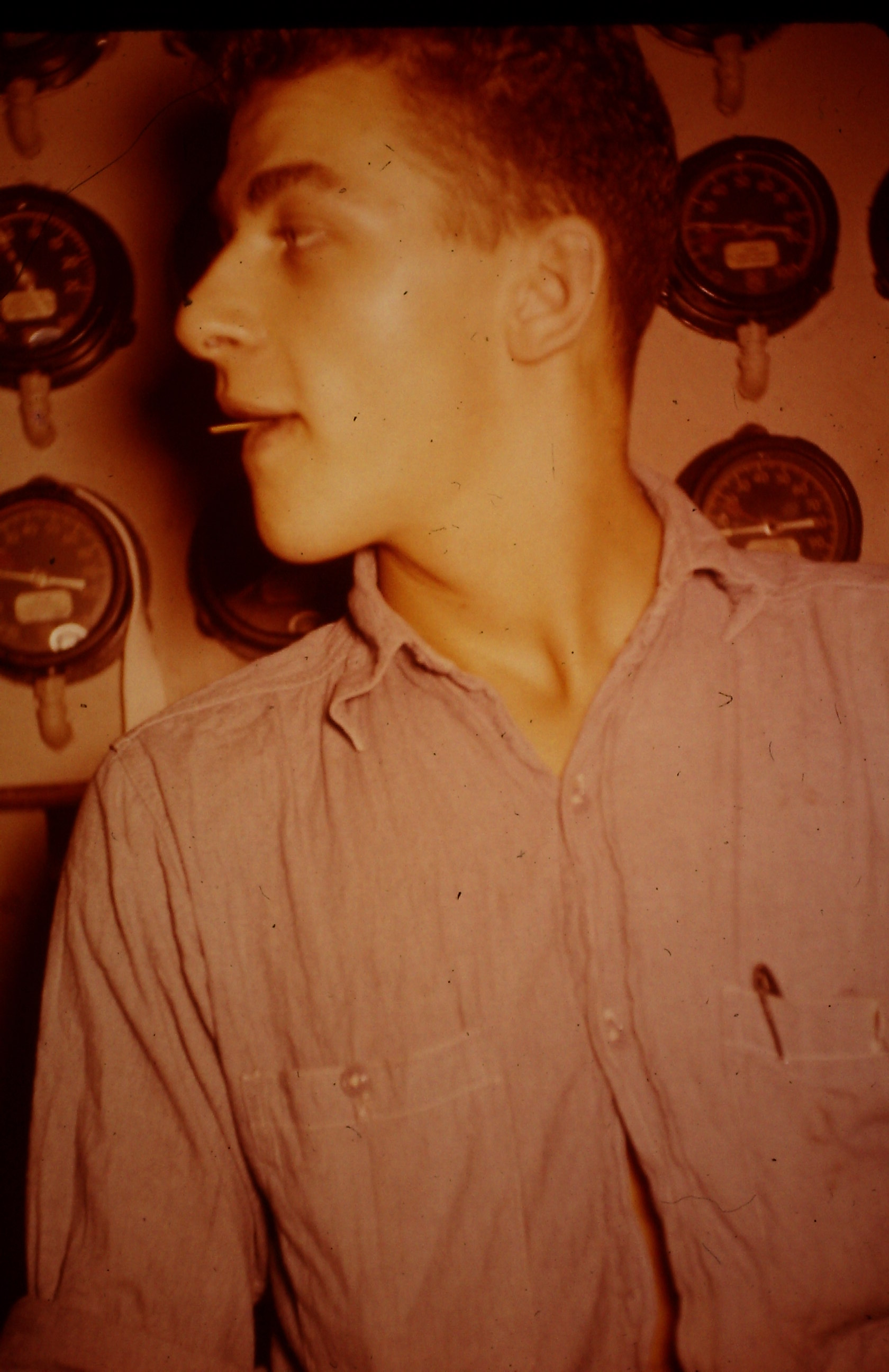
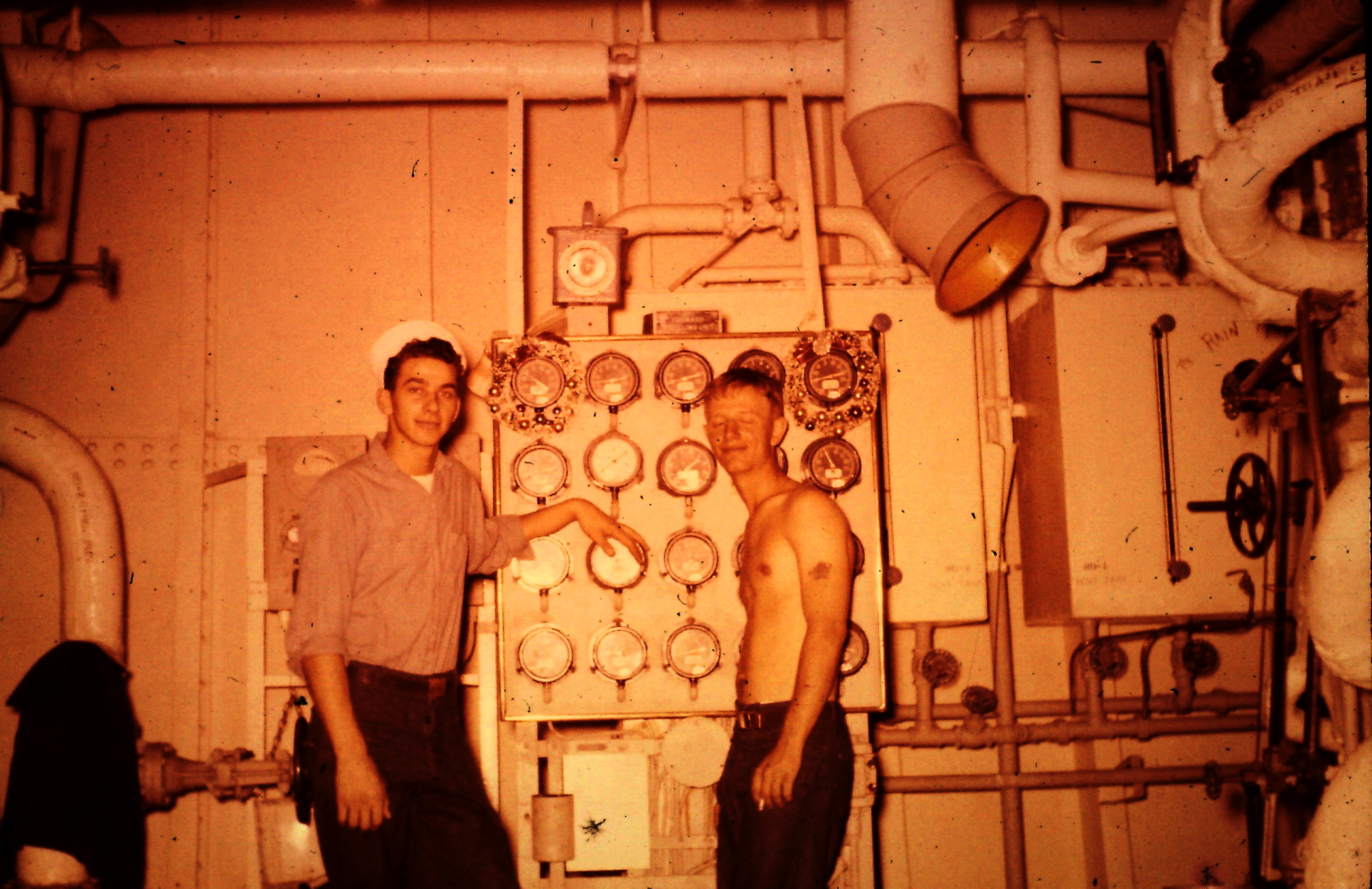
Photographs of the Calvert’s “A” Division areas and crew.
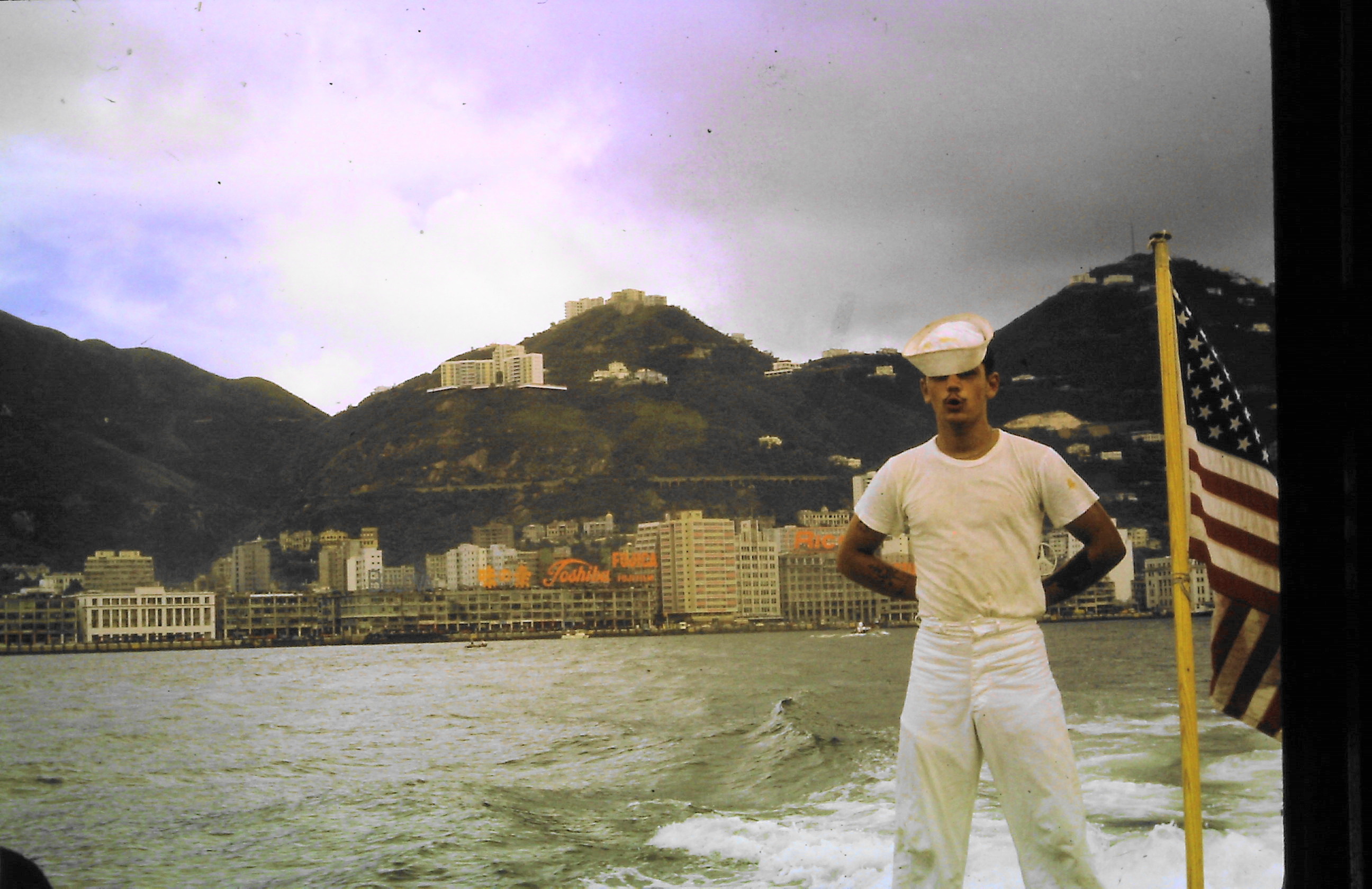
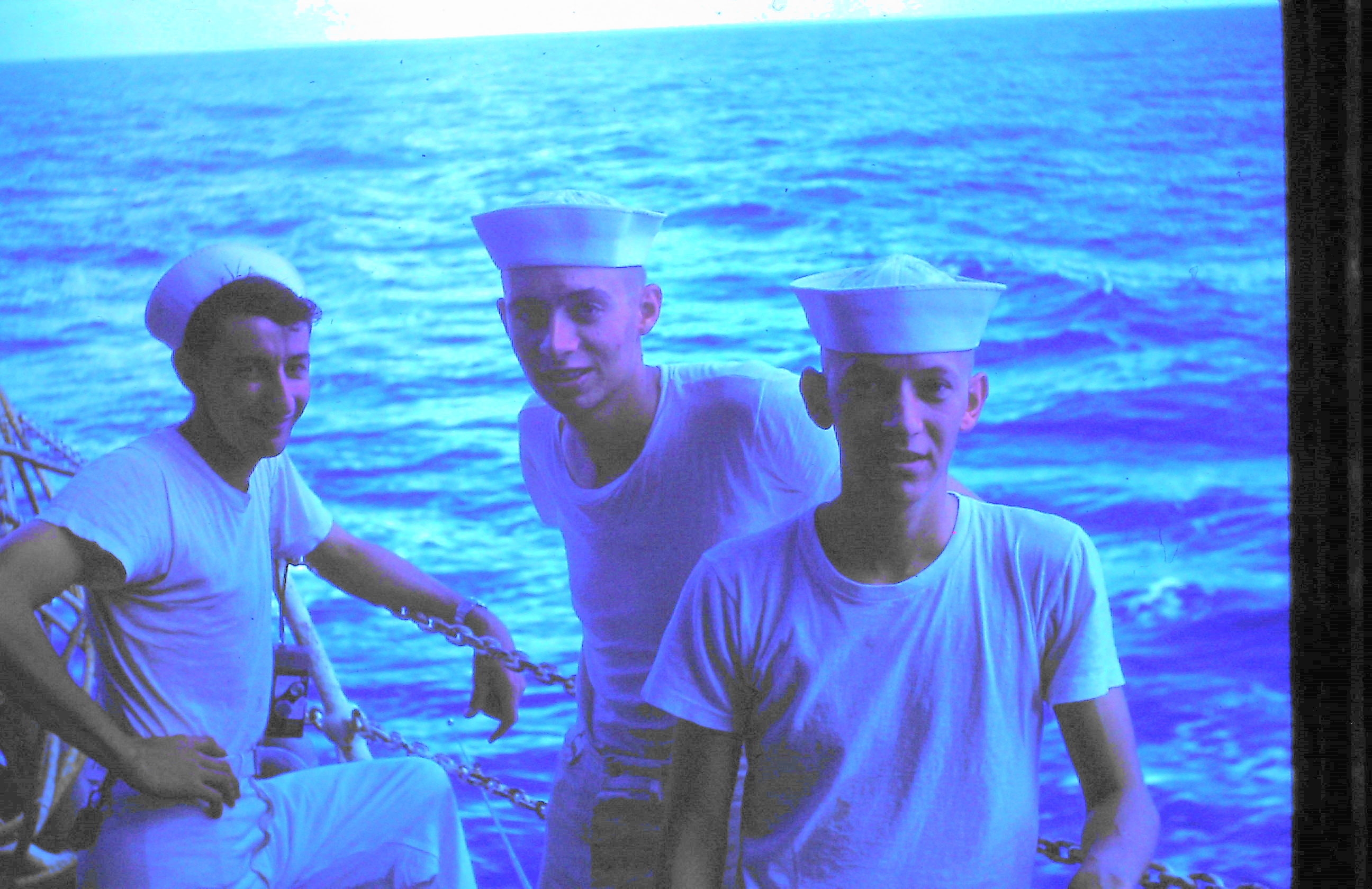
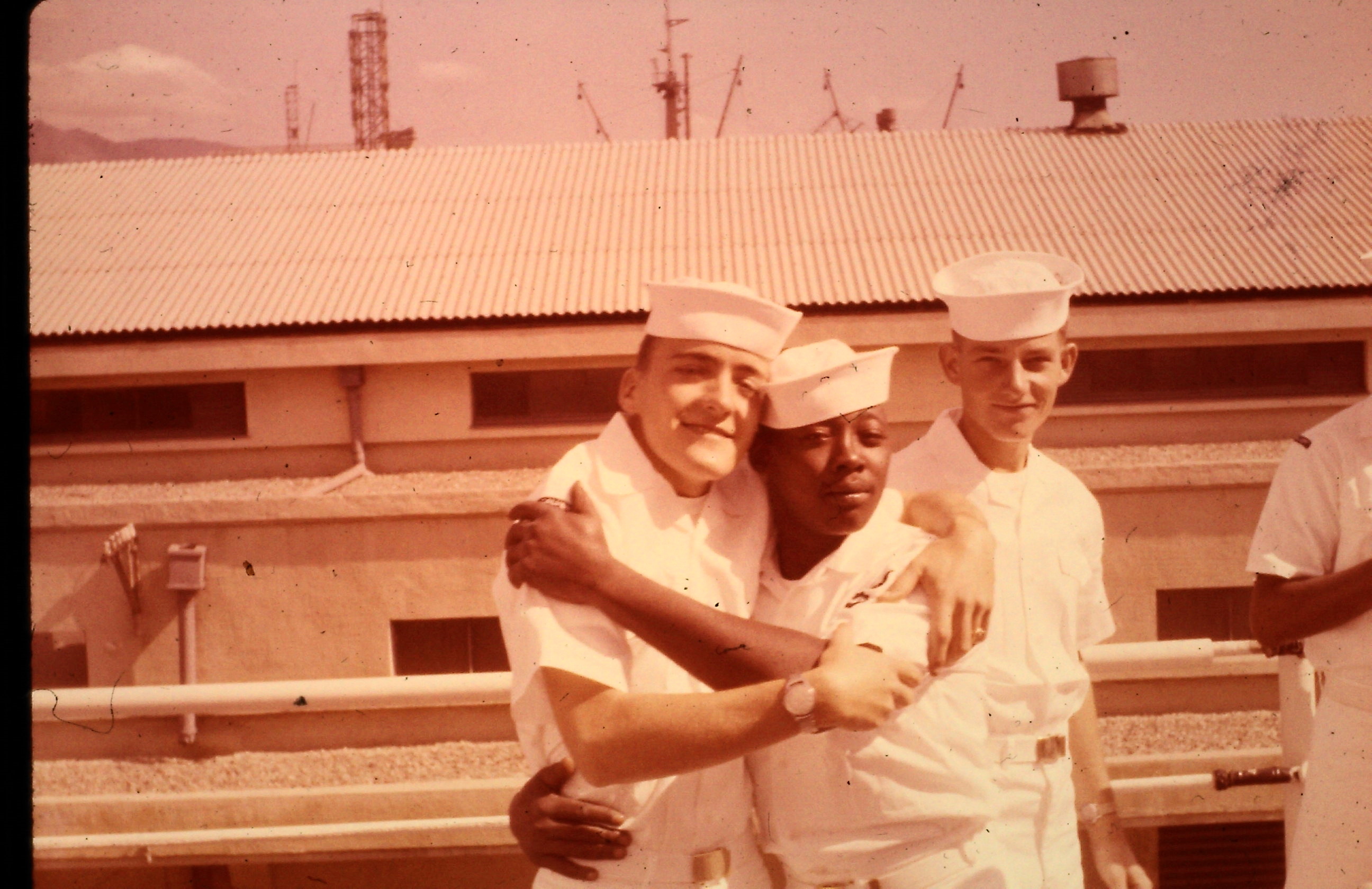
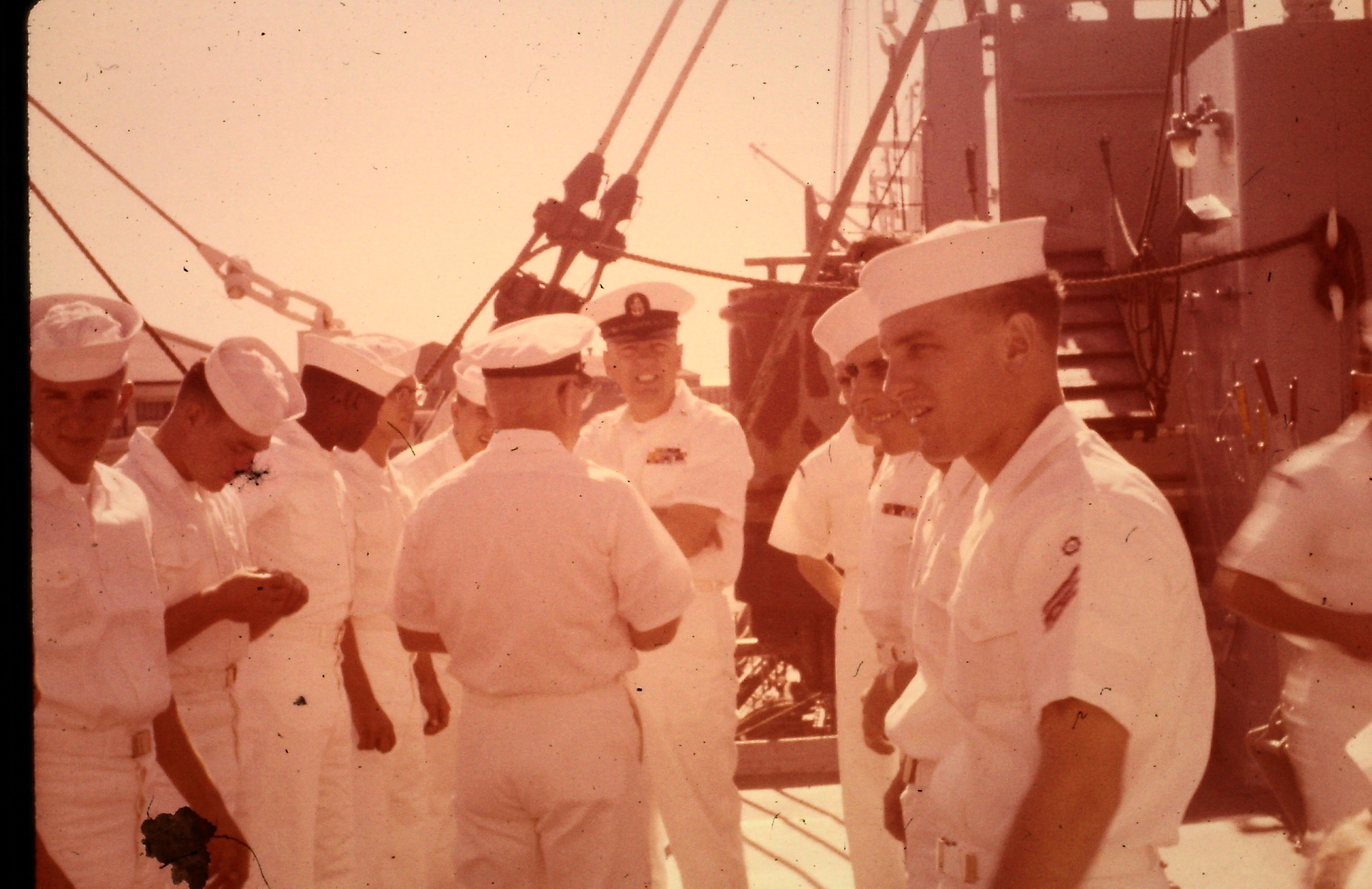
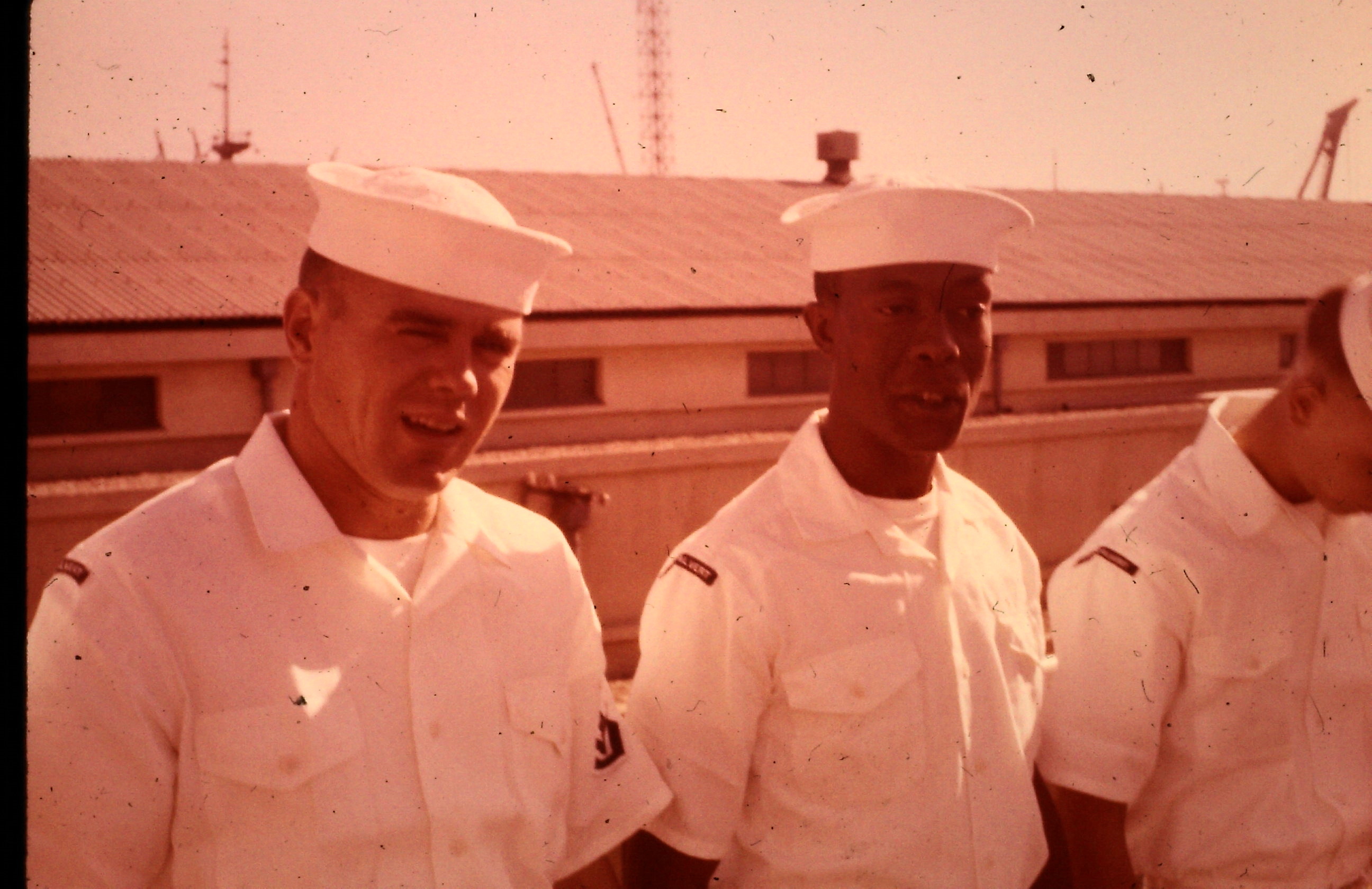
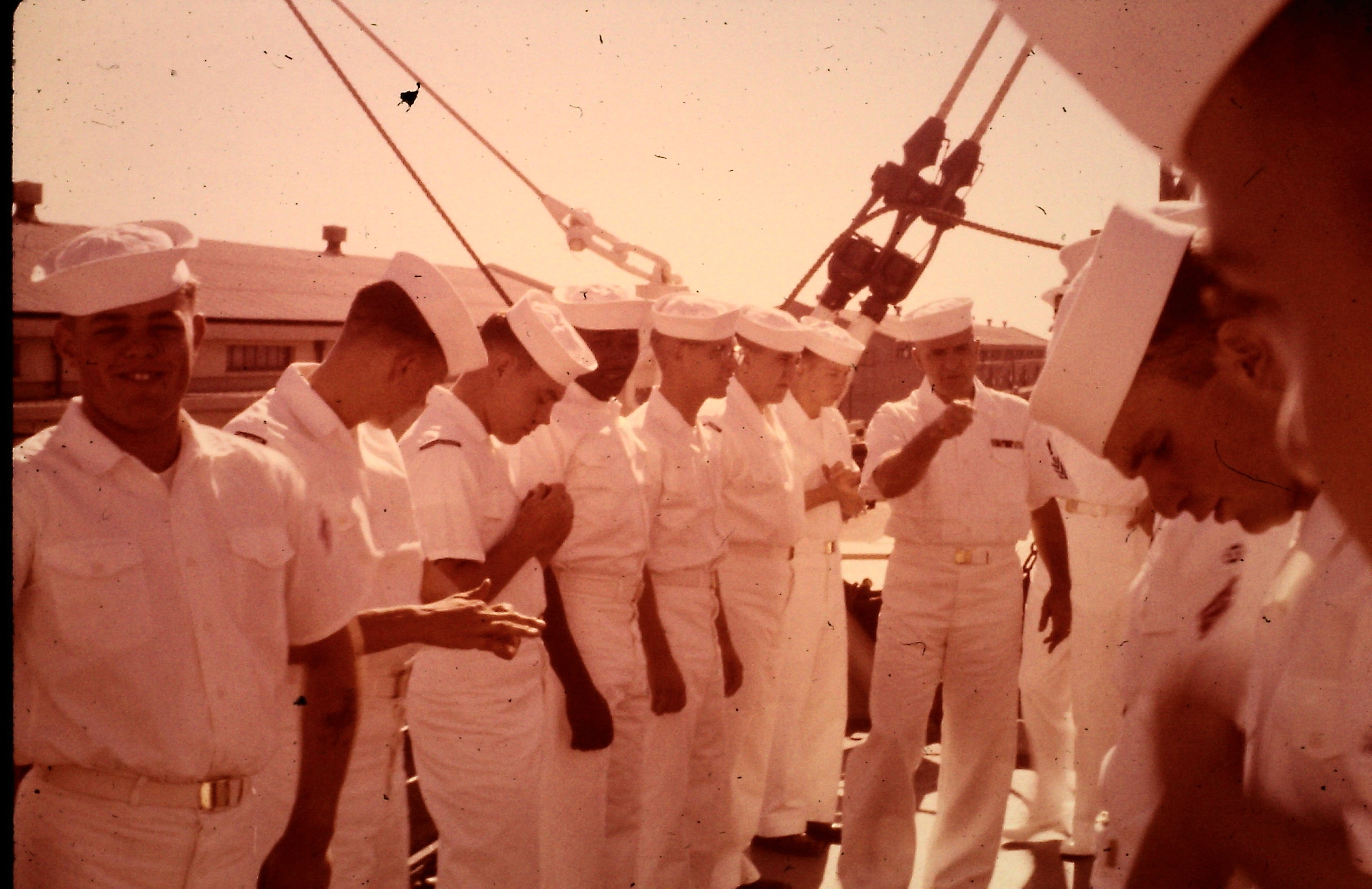
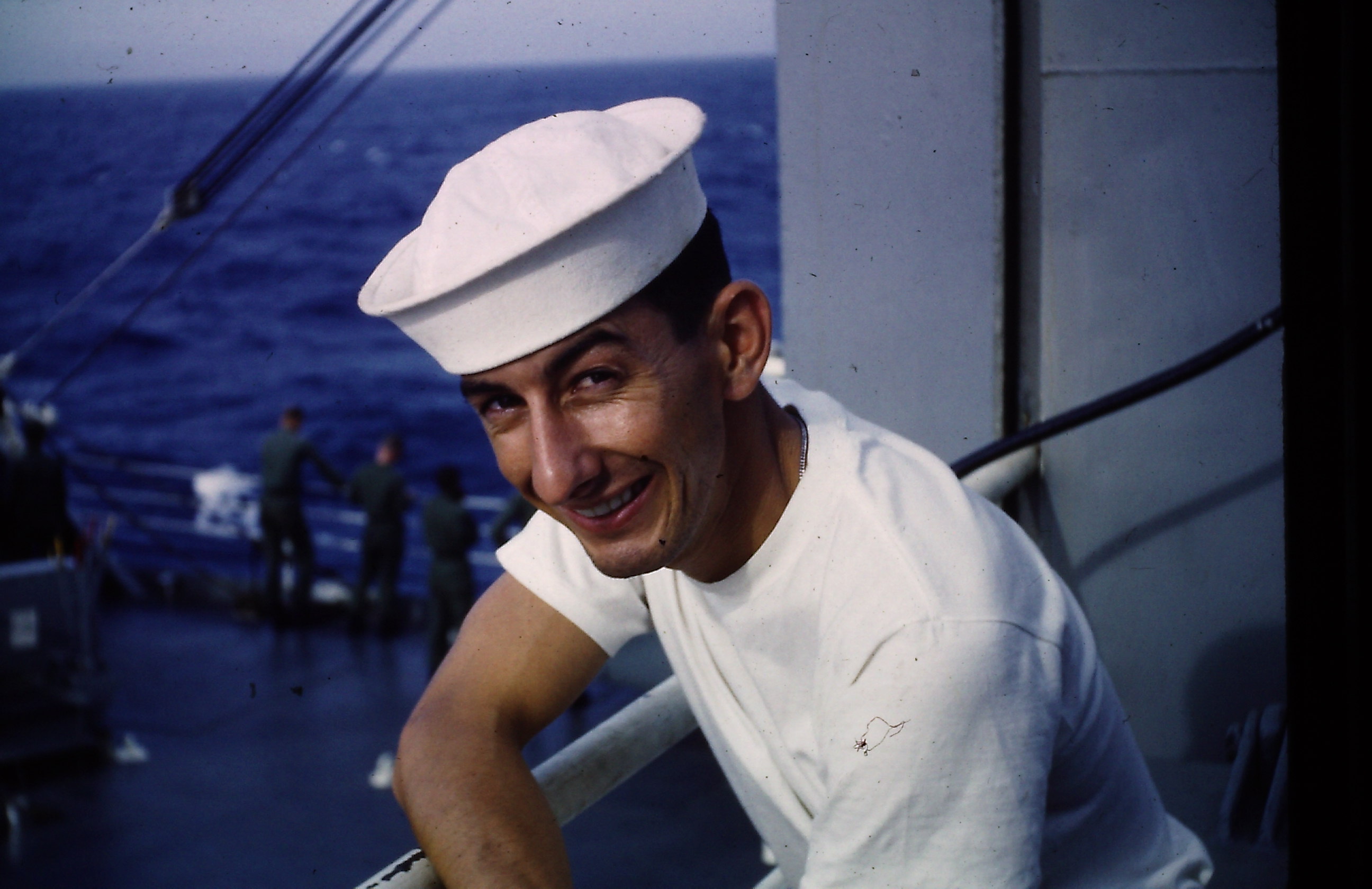
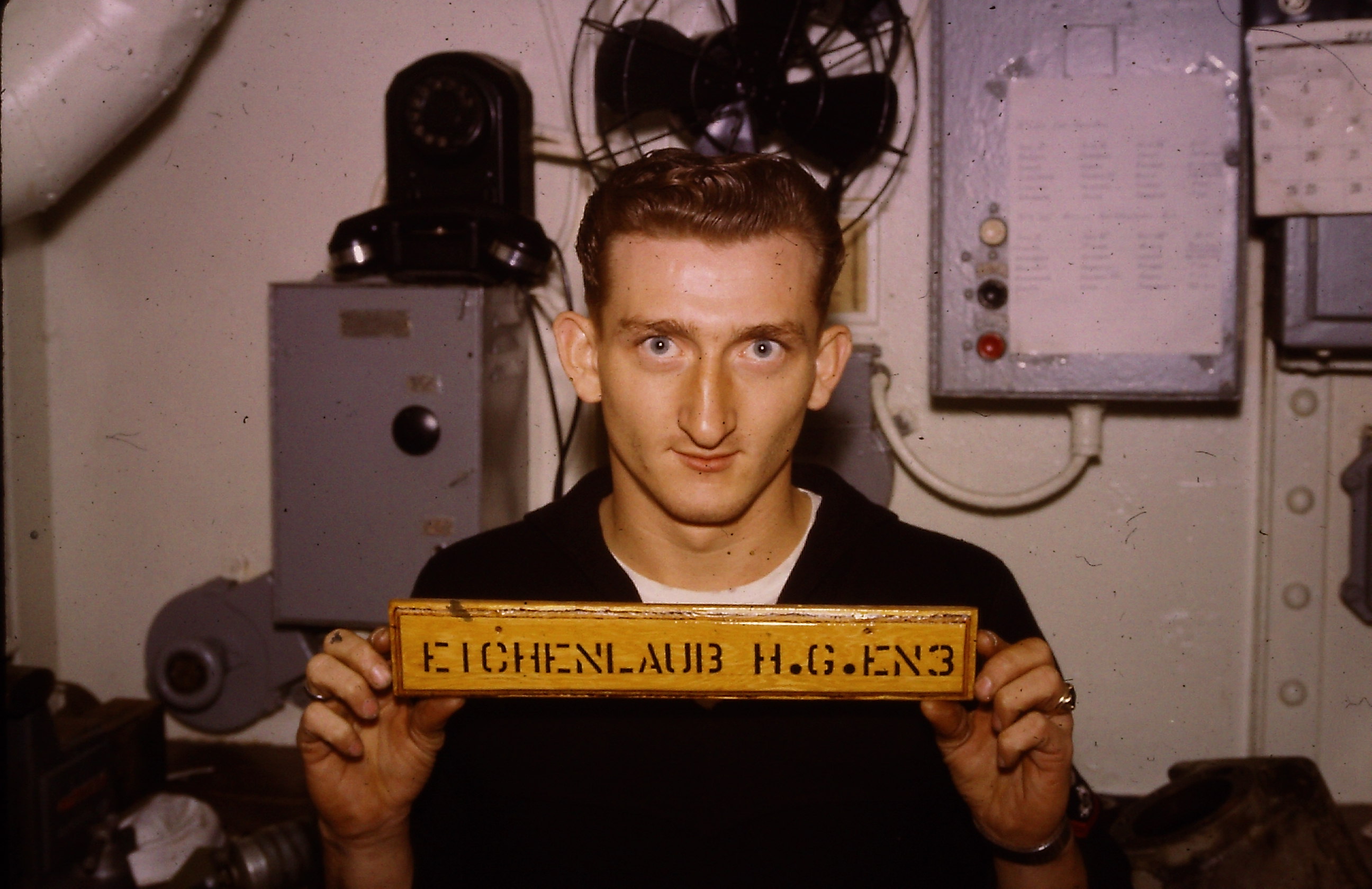
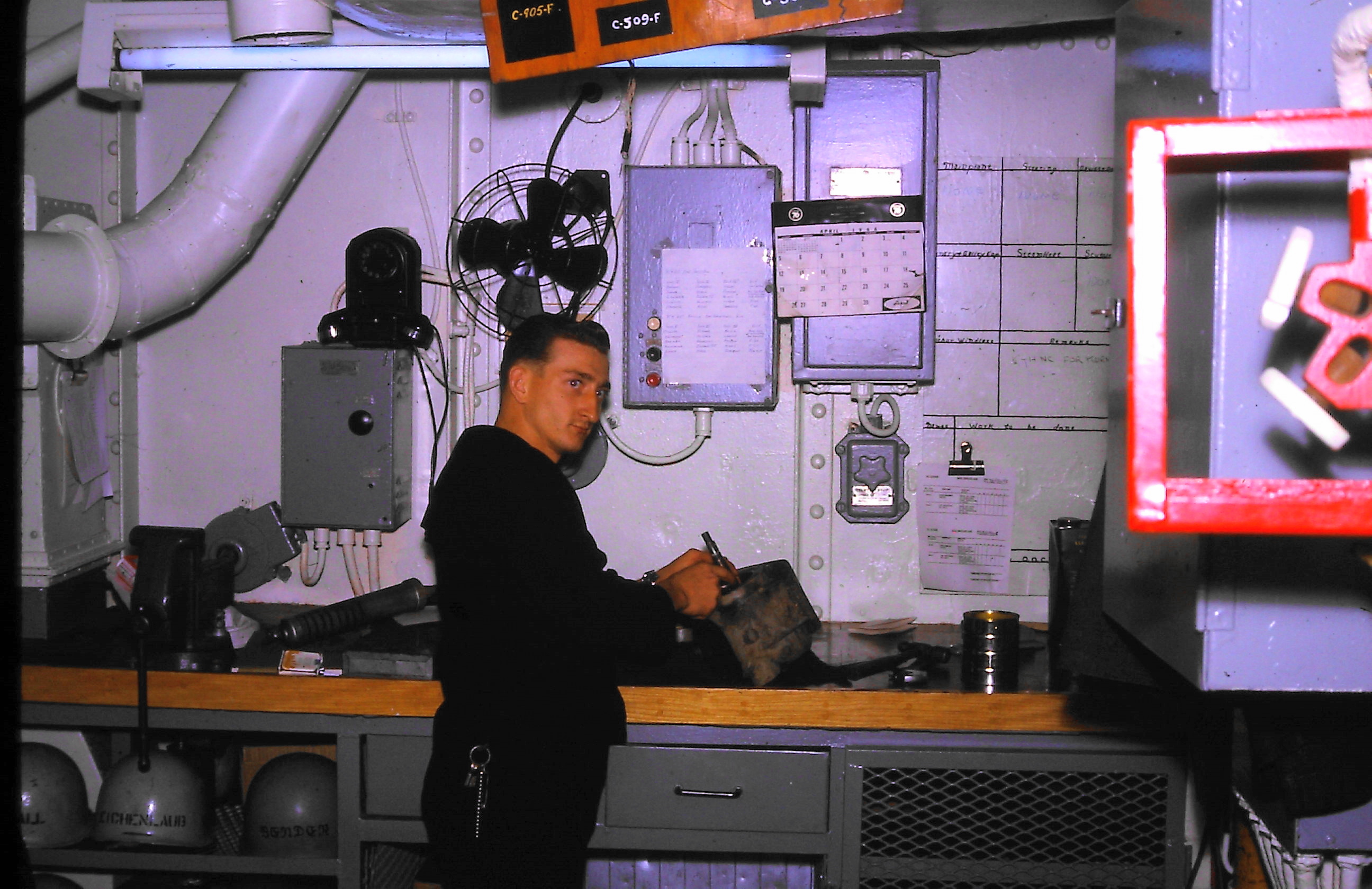
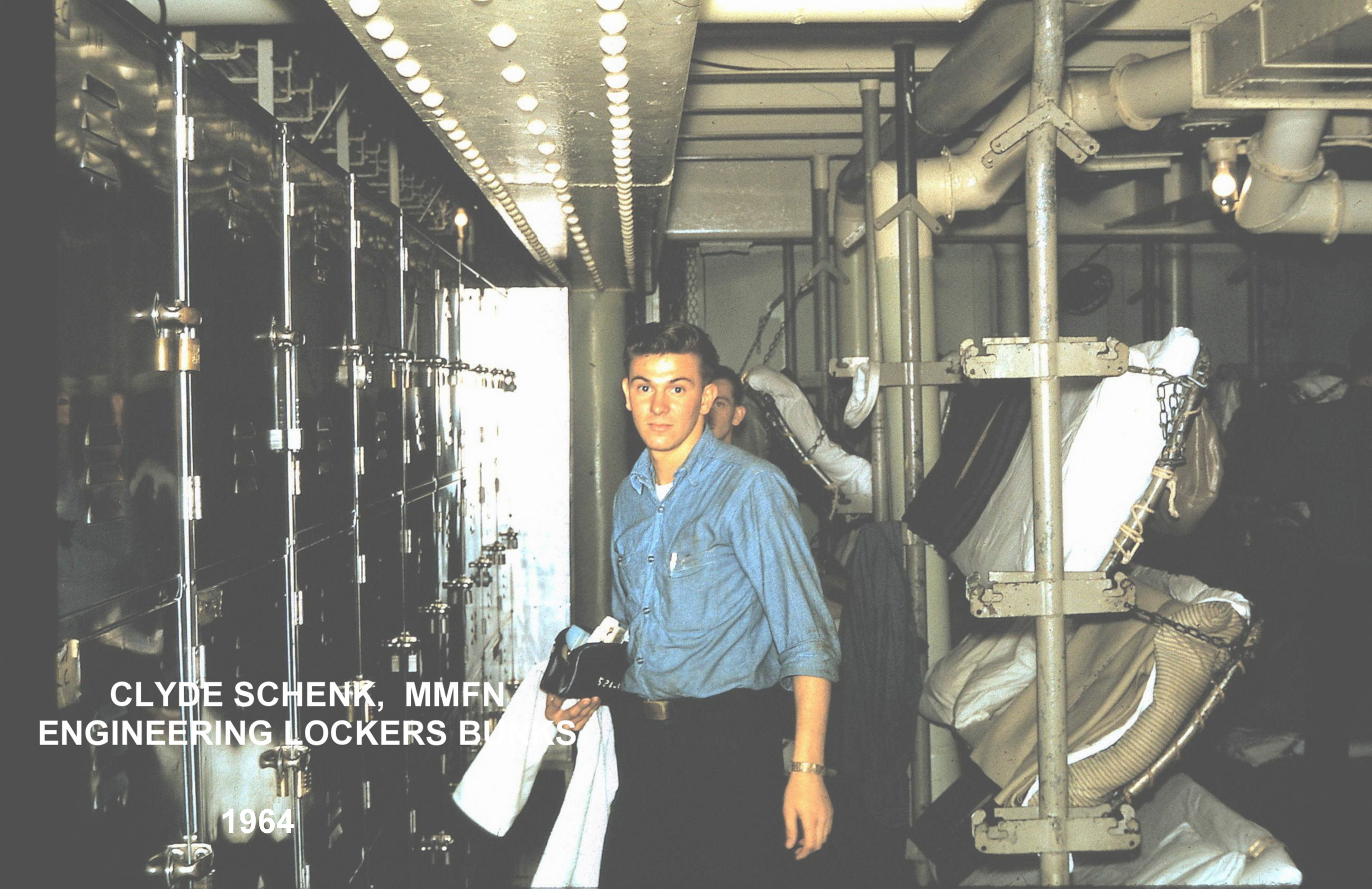
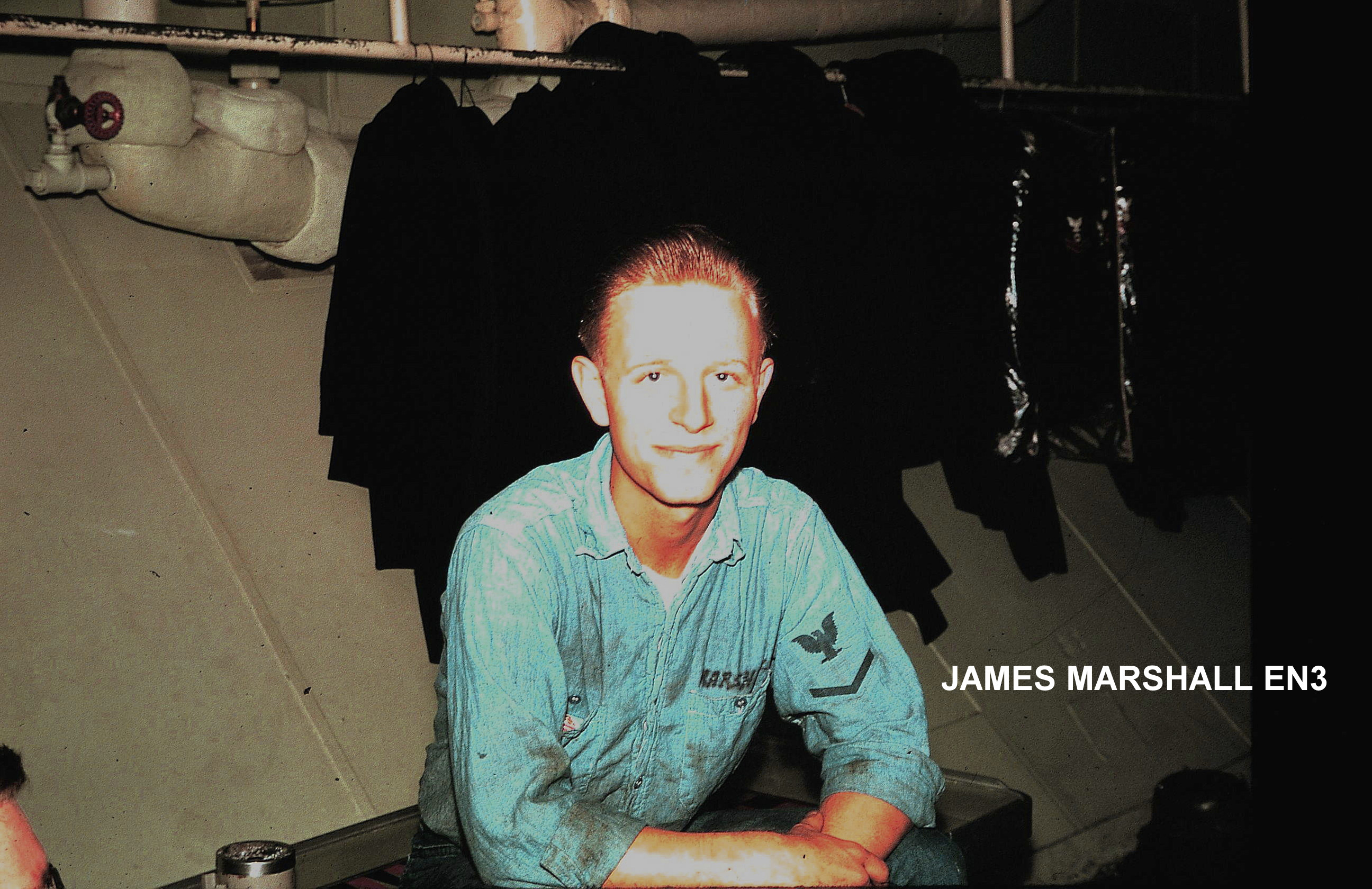
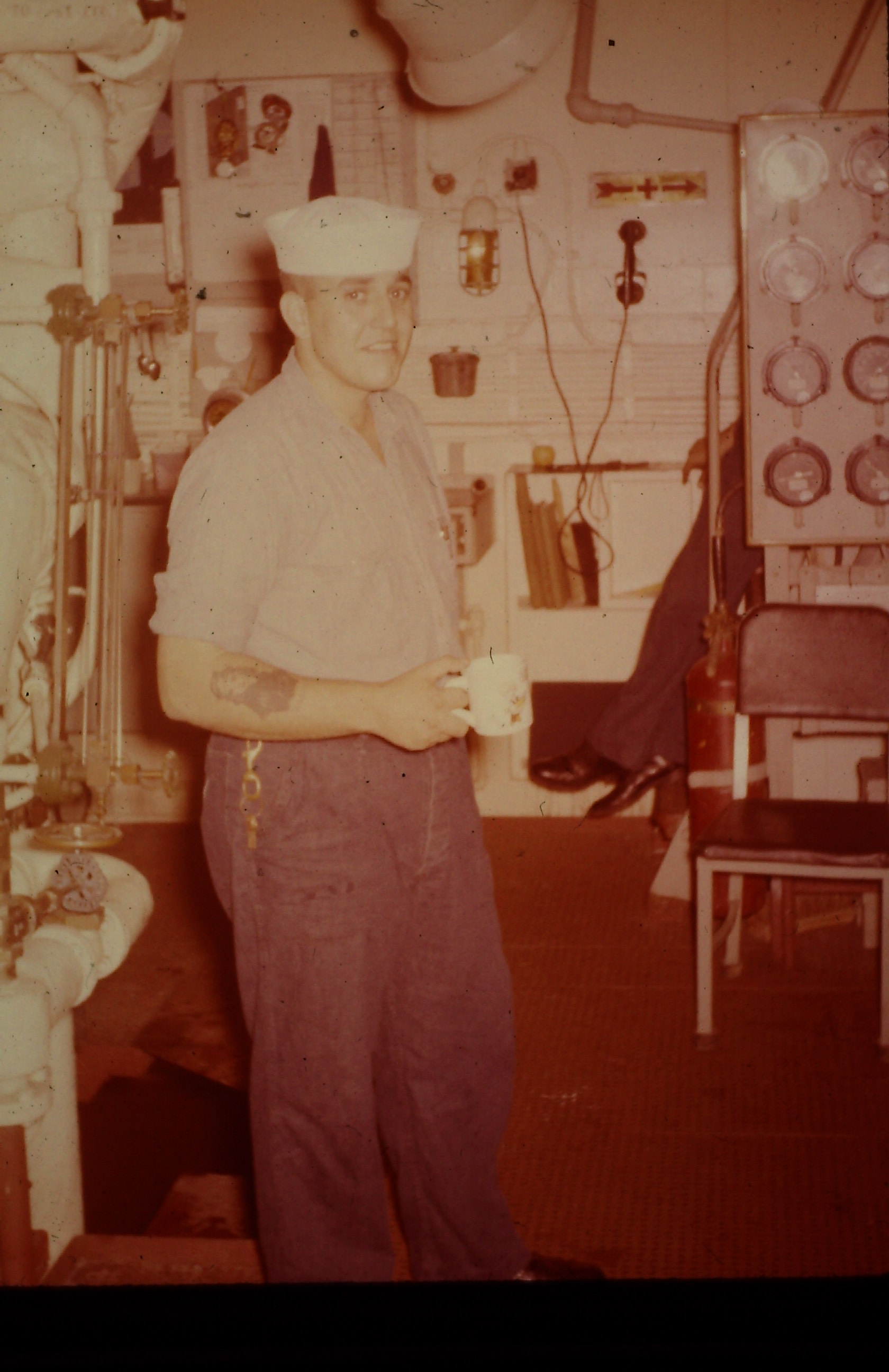
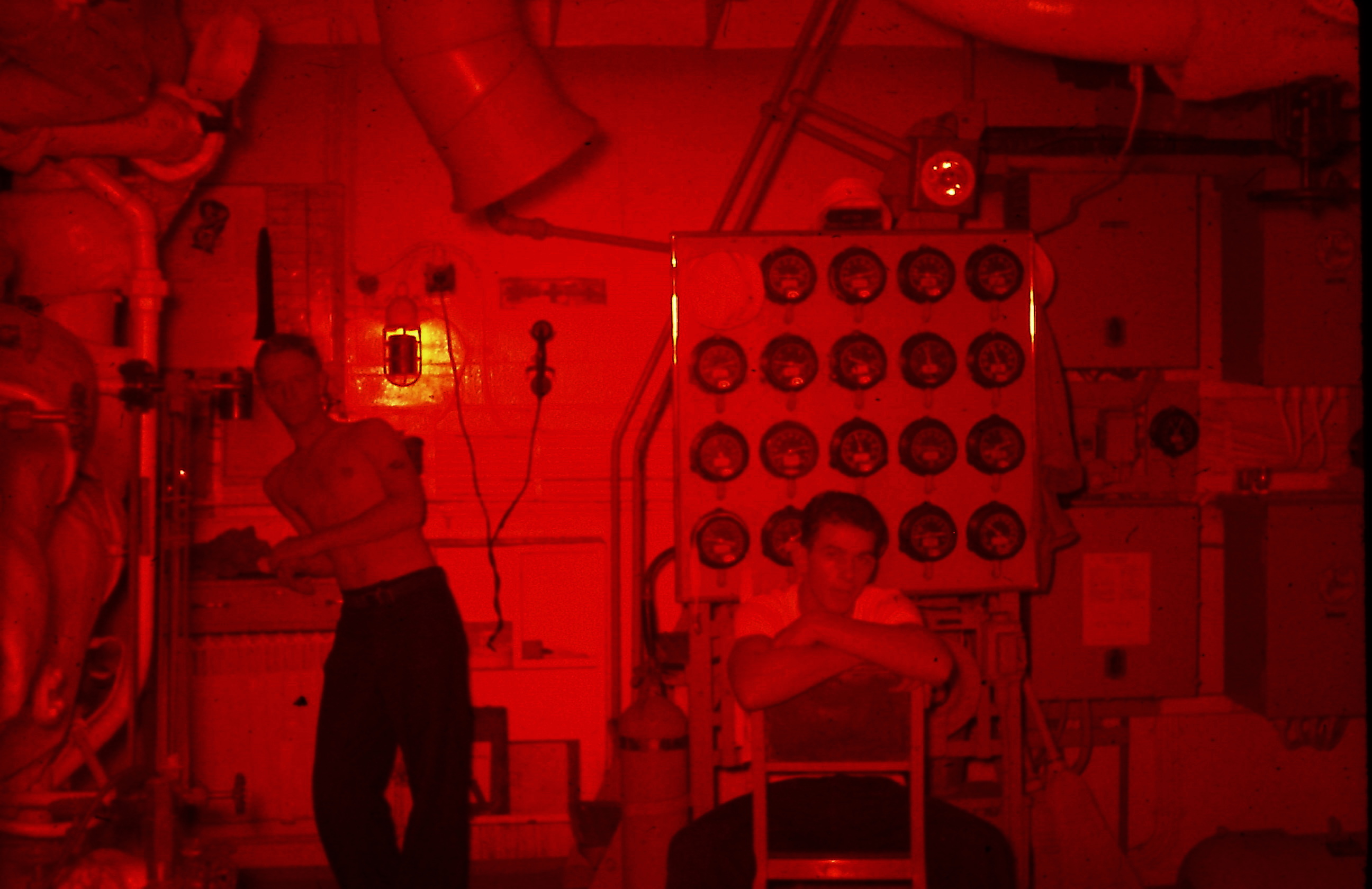
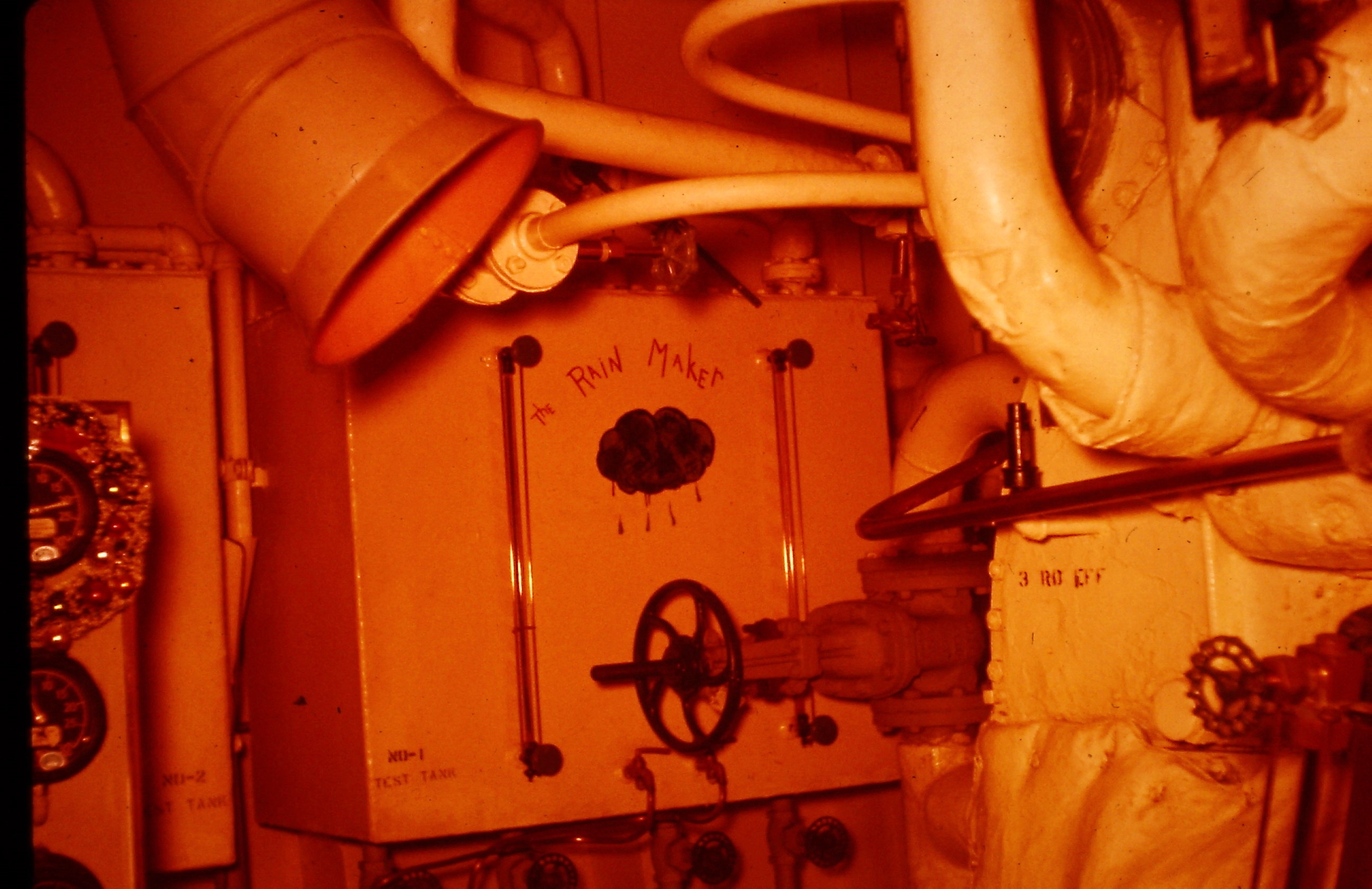
Steve Straka (MM2, “A” Division, 1962-1965) provided these photographs from his time aboard the Calvert during the 1962 and 1964 WEST PAC deployments. Steve explains:
“A Division was part of the engineering, fresh water, air cond. steering gear, we repaired the winches for the cargo booms, and most important of all, we repaired and maintained the motors on all of the boats on board. We also were on all the boats when they were operating, landing operations, liberty and mail runs in port. I was in charge of the evaporators and air cond.”
Click on a picture to open a full resolution copy in a new window.
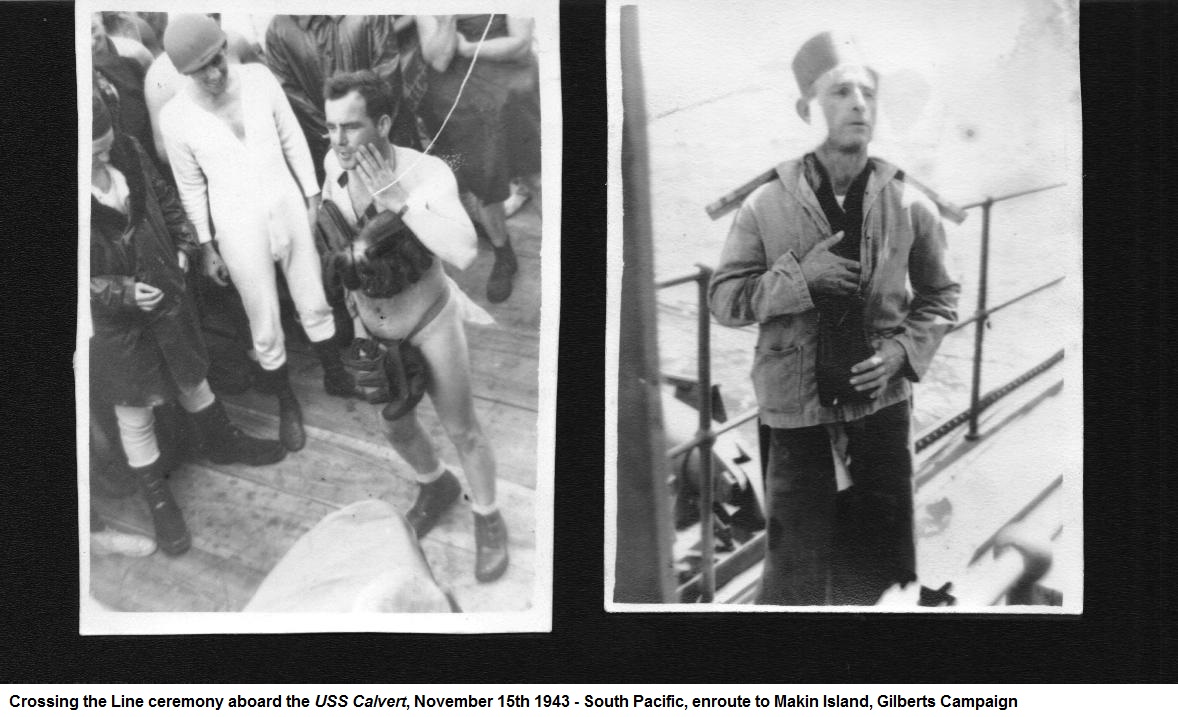
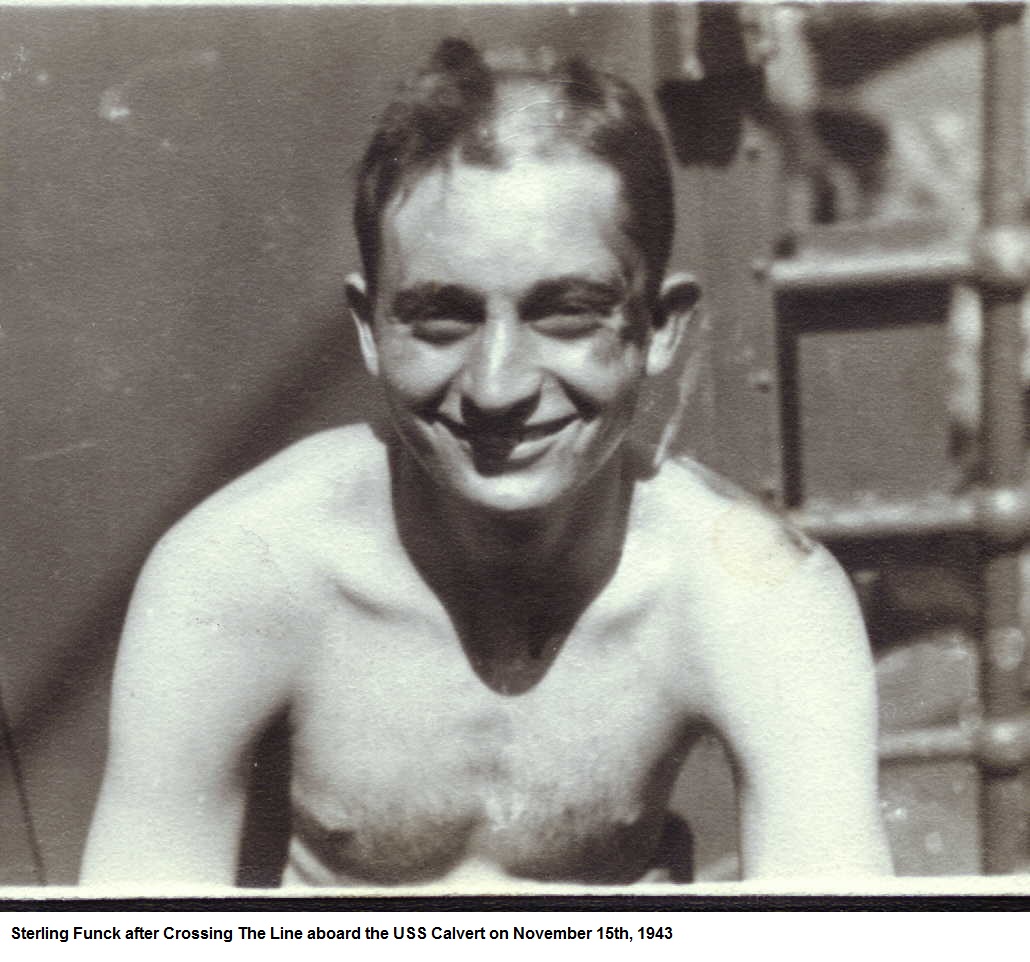
The Crossing the Line ceremony was (and still is) held anytime a ship crosses the Equator. In the case of the Calvert, the ship crossed both the Equator (Shellback ceremony) and the International Dateline (Golden Dragon ceremony) on November 15th, 1943 while en route to Makin Island to participate in the Gilberts Campaign. This was the Calvert’s first crossing and was cause for a monumental ceremony, even in the midst of her voyage to her first invasion in the Pacific and under threat from enemy planes and submarines.
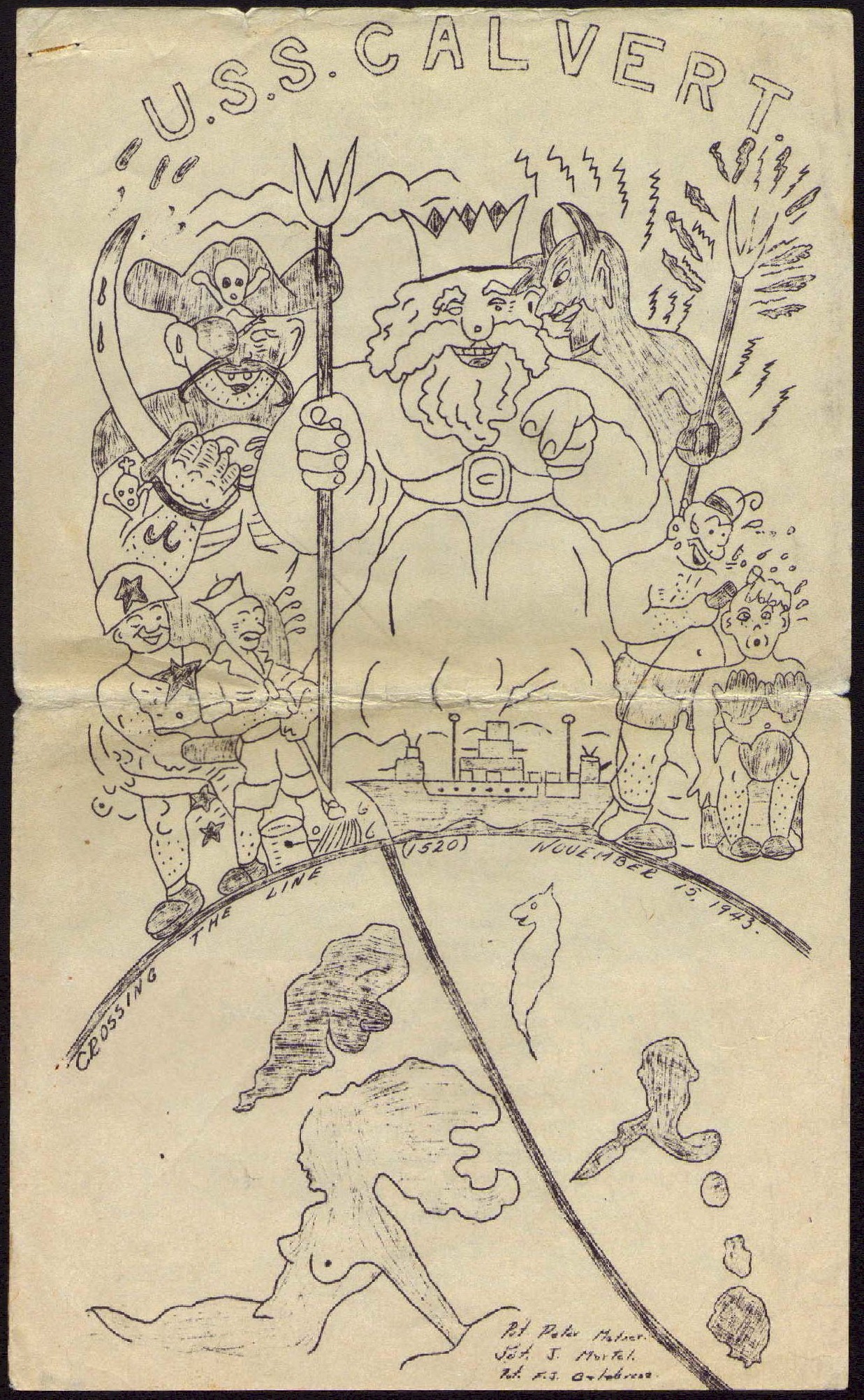
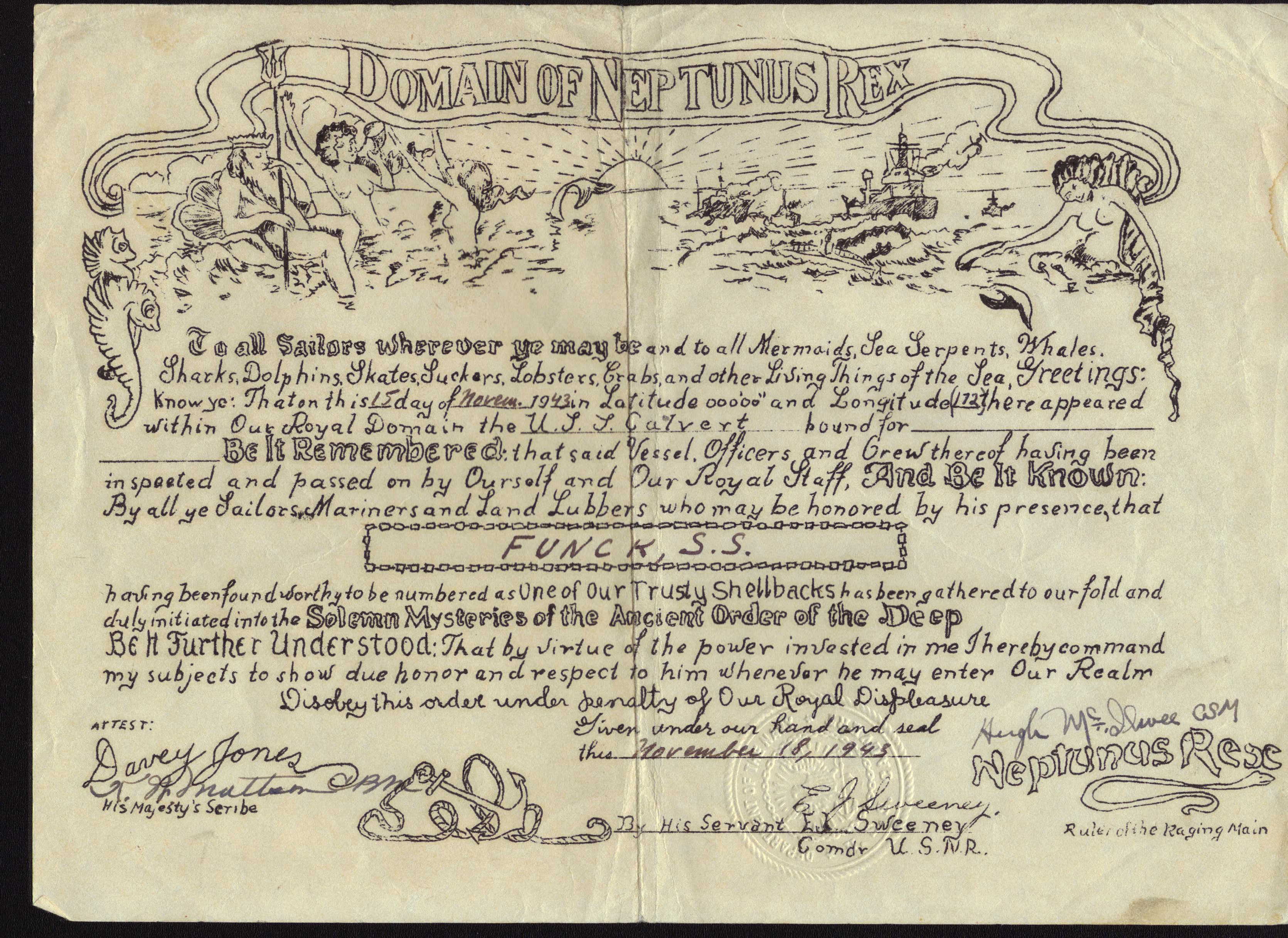
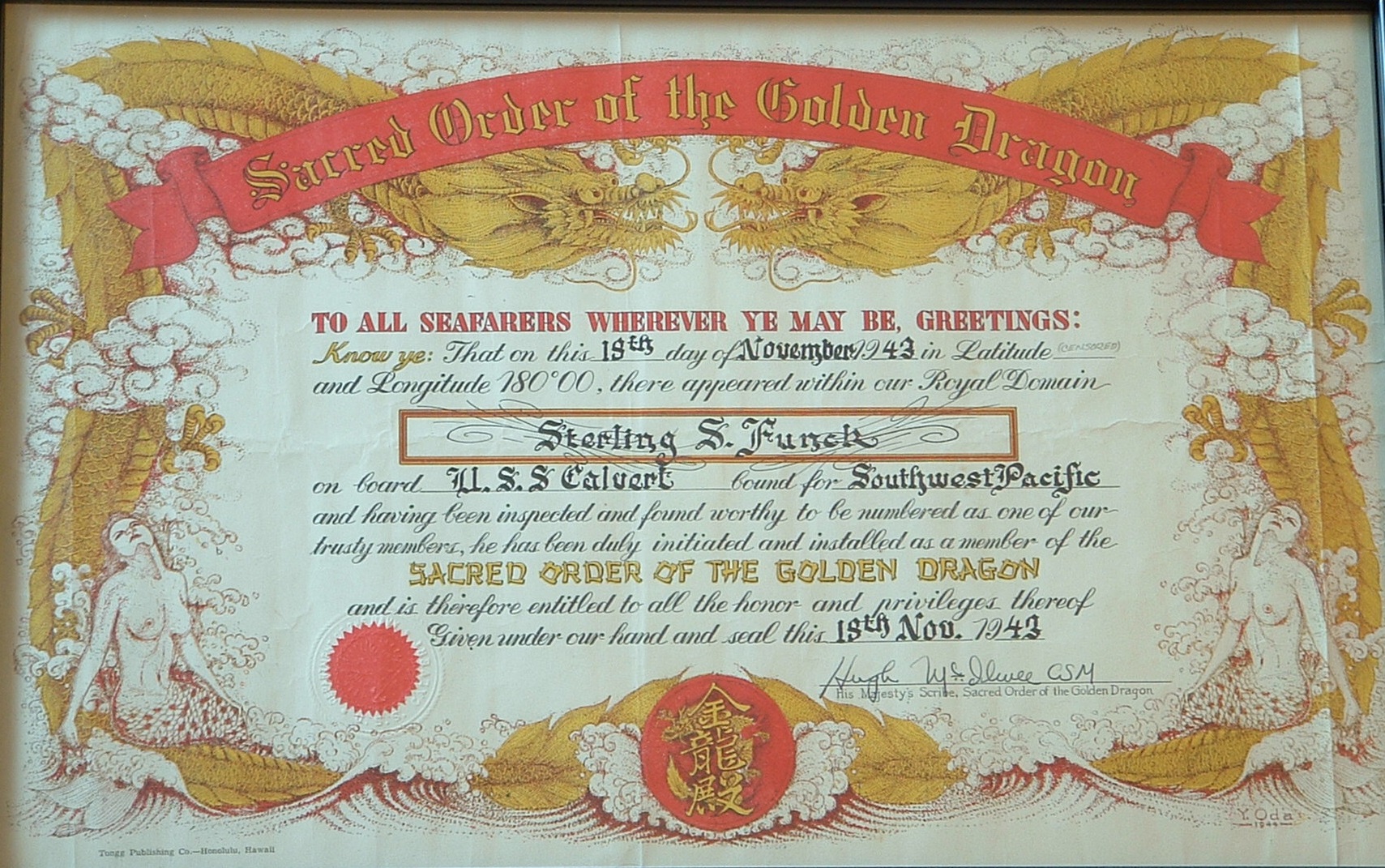
The “How The U.S.S. Calvert First Crossed The Line“ (.pdf document) document was produced onboard the ship with a hand-drawn cover. My grandfather, Sterling Funck, received this original copy of the document with his participation in the Crossing the Line ceremony .
The written document itself was compiled by Lt. (jg) Abe Weinberg, ship’s secretary and War Correspondent Harold P. Smith of the Chicago Tribune. These soldiers were members of the US Army’s 165th Infantry Regiment, 27th Infantry Division.
The cover (left) of the booklet was designed by Private Peter Metzger of Fresno California, assisted by Sergeants John Gonzales and Joseph Martel of New York City.
The full text of this document is available further below.
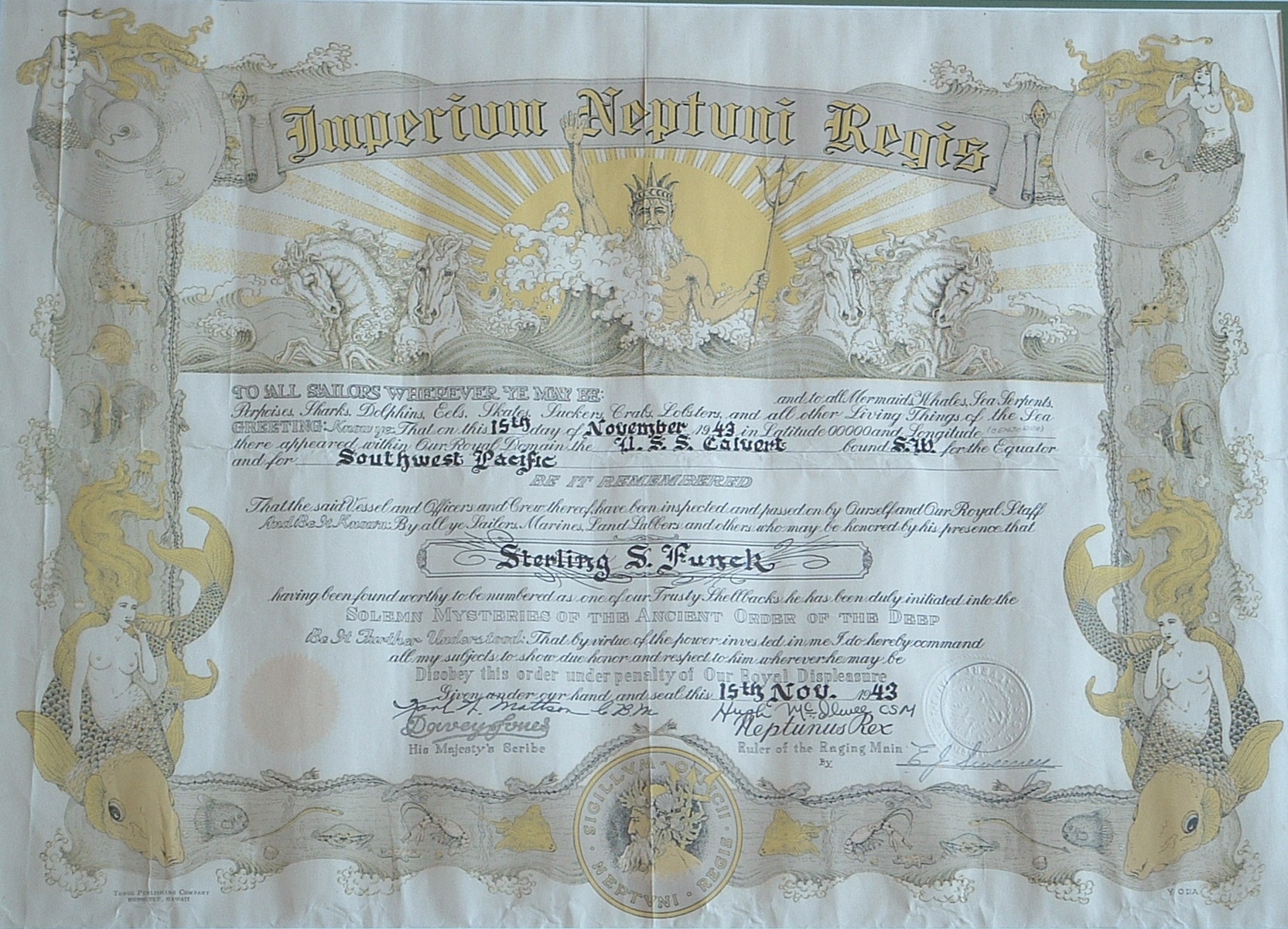
Here are several additional photographs and certificates from my grandfather’s collection:
BLANK LINE ……….
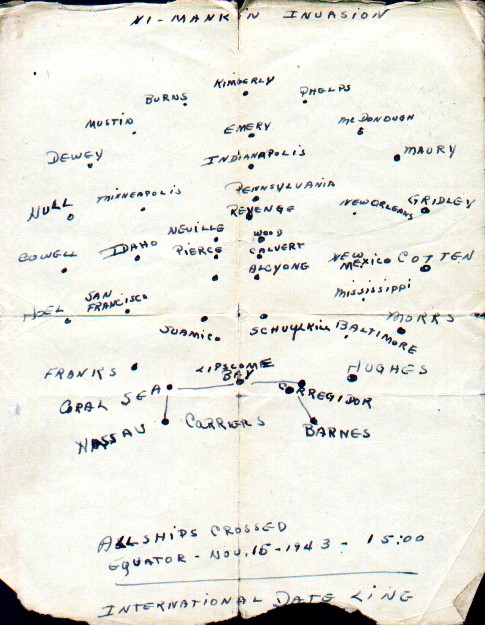
The following hand-drawn chart shows the fleet’s position at the time of the crossing.
This diagram was sketched by Walter “Fred” Cox while he was on duty as a radarman at the time of the crossing and the ceremony.
Full text of How The USS Calvert Crossed The Line – November 15, 1943
RESTRICTED
THE CRUISE OF THE CALVERT
She was the transport Calvert
And she sailed through winds and fogs
With a crew of soft-boiled shellbacks
And of hard-boiled pollywogs.*
All around her lay the convoy,
Every spar and gun was set,
And her oil was very greasy
And her water very wet.
Then her skipper took a bearing,
And he said: “Here’s where she’s at,
Though her longitude don’t matter,
She is 0,0,0 in lat.”
So they cleared the hatch for slaughter,
Though they weren’t near a Jap,
For a Shellback loves his mayhem
Like a baby loves his pap.
And the Pollywogs ran gantlets,
And they felt the barber’s grip,
For a day the transport Calvert
Was a bloomin’ clipper ship.
And the quarters smelled like bilges,
And the decks stunk like latrines,
As the Shellbacks had their innings,
Army, Navy and Marines.
But the Pollywogs united,
No, they didn’t play it dumb—
They united with the Shellbacks
And sang: “Tokyo, here we come.”
* This ballad was written, as may be suspected, by a Pollywog, Lieut. Col. Sam L.A. Marshall, AUS, of the historical branch of the Army’s G-2 staff in Washington, an observer this trip.
DRAMATIS PERSONAE
All Original Shellbacks
ROLE
NAME
NEPTUNUS REX
MC ILROY, Hugh, CSM
QUEEN AMPHITRITE
MARVIN, William B., RM3c
ROYAL BABY
GREGORY, Roy G., CEM
DAVY JONES
MATTSON, Karl R., CH
ROYAL DOCTOR
ALLYN, William B., CSK
ROYAL CHIEF JUSTICE
MURPHY, Thomas E., Chief Pay Clerk
ROYAL NAVIGATOR
HENRY, Harry J., Chief Carpenter
ROYAL BARBERS
CARRIE, James F., Lt.; LEE, M.W. CSF; PRINZO, Louis F., Cox.
ROYAL DENTIST
PARADISO, John, Acting Pay Clerk
ROYAL CHAPLAINS
RYLAND, R.E., Major, USMC; FRERE, Francis, CSF.
ROYAL PHOTOGRAPHER
STOLP, Robert, Lt. (jg).
ATTORNEY
D’ELISCU, Francois, Lt. Col., USA.
EXECUTIONER
MC DANIELS, Leon, St.3c
CHIEF OF POLICE
RAWLS, Laurie B., CEM
LEADER OF BEARS
MITCHELL, Casimir J., CWT
ROYAL COPS
ROYAL BEARS
SMITH, Gordon B., Lt. Cdr.
HUGHES, John H., Lt. Cdr.
MONTGOMERY, John H., Lt.
GRAHAM, Pierre, Ensign
MARKS, William B., Lt. (jg)
FITZGERALD, Frank, Machinist
BROCKLEHURST, Ralph, CM1
CROSSON, James J., CM1
KOHLRUSS, Rudolph T., BM1c
HANSEN, Robert R., WT1c
FAYARD, Louis H., MoMM2c
HOEY, Ottis O, WT2c
CHOATE, James B., FC3c
ARLAGUE, Enrique S. CK2c
BERNARD, William F., S1c
CARVER, Edward D., F.1c.
RESTRICTED
HOW THE U.S.S. CALVERT FIRST CROSSED THE LINE
Disdaining global war as a mere ripple in civilization’s onward flow, too trivial for interference with the enduring traditions of the sea, Neptunus Rex, Emperor of the Deep, took command of the U.S.S. Calvert as she made her first crossing of the Equator on November 15, 1943, outward bound with an amphibious combat group for the opening of the Allied offensive in the Central Pacific.
For several hilarious hours before the Crossing, the legion of Pollywogs and Landlubbers aboard were prepared for initiation into the honored ranks of Shellbacks for whom the transit is a part of the past. Not even the sharpest sense could have detected that these merry celebrants, their huge energies wholly given over to light-hearted conformity with a custom that goes far back into antiquity, were tough fighting men a few short days from a battle that for the great majority would be their first.
Atrocious haircuts, grease-coated decks, oil-smudged clothing and gingerly approach procedure of the sore-bottomed initiates on taking seats at mess, all were amusing reminders for days afterward of an event planned and executed with astonishing success under trying circumstances, not the least of which was that the fact there would be a crossing was not disclosed until after the transport had put off on her combat mission. The speed and ingenuity with which costumes and equipment sprang up out of nothingness were shining tributes to the originality and resourcefulness of the small handful of Shellbacks on whom the formidable preparation task descended.
The obvious boost in already high morale among the troops, and the cordial intermingling of army, navy and marine corps officers brought about by the madcap goings-on were effective proofs that the boisterous American sense of humor is a war asset that confers a tremendous advantage over stolid foemen.
True to tradition, the activities began on the eve of the crossing with the arrival aboard of Davy Jones, secretary and first assistant to King Neptune, to serve subpoenas and otherwise set the stage for the big show of the morrow. For this occasion certain Pollywogs were required to turn out in appropriate costume, and to make obeisance to Davy and his party on the Calvert’s navigation bridge.
Just before Davy arrived, the Pollywogs, too spirited to take their approaching punishment lying down, got together in the morning before the Shellbacks, badly outnumbered, could organize, and roved the ship from stem to stern like a wolf pack, intent on mischief to their prospective oppressors.
Capturing members of the Crossing the Line party, the Pollywogs bundled them off to improvised cells, holding them prisoner for two or three hours before Davy Jones arrived to assert Shellback supremacy. One Shellback in a winch locker turned a salt water hose on his captors, who retaliated by nearly drowning him in his dungeon below decks.
Not all the Shellbacks gave in without a struggle. A commotion at any point on the crowded ship meant probably that the Pollywogs had rounded up another Shellback who scorned going to the jailhouse under his own steam, wherefore auxiliary propulsion was provided by as many husky Pollywogs as could lay hands upon him.
Typical of the Shellback reaction to this indignity was that of hard bitten Maj. Robert K. Ryland, who spent more than two hours behind a grating in the hot confines of a machinery locker. Through the chinks of the grating poured a never ending stream of words the major did not learn in church.
“Let me out of here, you blankety blank sons of so and sos, you,” the prisoner stormed, rattling his door mightily. “I’m the friggin’ Royal Chaplain and you can’t do this to me.” But the Pollywogs loftily pretended not to hear and trudged doggedly off through the officer’s quarters in quest of a few of the royal retinue they had overlooked.
-1-
R E S T R I C T E D
Davy Jones was greeted on his arrival from the deep with this speech by War Correspondent Harold P. Smith of the Chicago Tribune:
Distinguished dignitary of the delveless depths, liege lord of the legendary locker, worthy wheelhorse of the watery wilderness, beneficent bulbul of the boundless bottom, august amanuensis of aqueous authority, mighty mariner of millennial magnificence, in behalf of my inconsequential self and other puny pollywogs, tad- poles, mudpuppies and amoebas, I humbly greet you.
Calloused as we are by our enforced and prolonged proximity to *Ferocious Francois D’Eliscu, casehardened though our counten- ances may have grown from the physiognomical awards set us by **Ball Buster Kelley, Lieutenant Colonel, Army of the United States, we can yet only thrill and again thrill unashamed at the auspiciousness of a visit in our own sphere from a personage of your fame and prerogative. Privileged indeed to know ourselves to be, thus to indulge our preview through the rime mists of eternity of the cosmic storekeeper seen in normal course only by those who have repaired irrevocably to that mysterious bourne whence no traveler returns.
It is in no sense a detripidigat to your lustigordibence to say that every Pollywog and Tadpole within sound of my voice is slig and durf with extremsascination. The inference is unmistakable. It means simply that, were it not for us Smiths and Joneses, the army, navy and marine corps would be far easier to feed, and the war itself might well devolve into a veritable verdibucitor.
That is why I can assure you with all the certinoeity at my feeble command that today will live forever in the perincee of our ladiberds.
Mr. Jones, ours are but the loftiest and least favored crannies of this establishment, but they are yours without stint or quali- fication. You may come aboard, but you won’t like it.
* Lt. Col Francois D’Eliscu, commander of army ranger and training school, accompanying this operation as an observer. ** Lt. Col. Gerard W. Kelley, commander of the army force aboard on this trip.
Davy responded to the speech by turning to a member of his party and saying: “Jeez, what was dat guy sayin’ about me.?”
Comdr. Edward J. Sweeney, captain of the U.S.S. Calvert, a Polly- wog, was then served with this subpoena, which he read aloud:
U.S.S. Calvert, On Entering Domain of Neptunus Rex. Notice and listen, ye Landlubber: I order and command you to appear before me and my court Nov. 15, 1943 to be initiated in the mysteries of my empire. If not, you shall be given as food for sharks, whales, pollywogs, frogs and all living things of the sea, who will devour you head, body and soul as a warning to landlubbers entering my domain without warrant.
You are charged with the following offenses:
Wilfully and falsely, with intent to escape initiation, saying in the presence of known Shellbacks, “I have already crossed the equator.”
Knowingly and wilfully steering ships of his command as far as possible from the Royal Domain to avoid official ceremonies.
Therefore, appear and obey or suffer the penalty.
Davy Jones, secretary to his majesty.
To Capt. Sweeney’s charges, as well as those of several other offenders was added the ominous phrase, “the United States then being in a state of war,” which added deep gravity to the accusations. The skipper was offered the alternative of supplying the royal party with sandwiches, which he chose because of his confining official duties.
-2-
RESTRICTED
The reception ceremonies over, Davy Jones commanded the caparisoned Pollywogs to follow him on a tour over all top decks, which wound up on a special pavilion on No. 4 hatch. There the Pollywogs, introduced by Davy as “the scum of the cart”, staged an impromptu performance under the jibes and direction of Davy and his henchmen. Two types of Royal Photographer were active here, one taking real pictures, the other squirting the miserable Pollywogs with an extremely persistent blue dye as they followed the admonition, “watch the birdie.”
No. 1 spot in the performance went to S.M.2c John Foley, clad in a sarong worn over an inflated lifebelt. He executed an inexpert hula.
Then came Lt.(jg) Edward L. Turner, Jr., costumed in longies, steel helmet and black socks, singing “I Come From Alabama.”
Lt.(jg) Francis H. Holmes, assistant medical officer, in full dress blues, in his rich southern accent sang “Marching through Georgia” so evilly he was ordered to swab the deck.
Lt. Col. Gerard W. Kelley, commander of the army group aboard in a sailor’s whites with blue flat hat, did an earnest but spotty hornpipe, occasionally wielding the swab he carried, on the deck.
S.K.3c Sterling Wesp, in long underwear, steel helmet and unmatched socks, sang a Hawaiian song whose words he didn’t know.
C.Y. James Meehan, in burlap shorts, white dress shirt and huge black tie, crooned “Paper Doll,” to the accompaniment of some applause.
Bos’n Robert Moon, resplendent in a pair of shorts several sizes too large, found them a problem of support during a Russian folk dance, in which he was required to keep his hands upraised.
Ensign Herbert Fielder, oriental in turban and sarong, piped a plaintive nautch show tune on a cheap tin flute, so realistically you could almost see the cobra.
St.M.1c Moses Bell, a typical mahout in his sarong, captured the fancy of the audience with a hootchie cootchie dance to the strains of Ensign Fielder’s instrument.
C.B.M. Eugene Del Grippo, in dress blue coat, oilskin pants, white hat and leather gauntlets, leggings laced on the inside, explained that he won the huge “Hero” medal on his chest in a crapgame.
1st. Lt. Patrick J. Raleigh, his bosom concealed behind two baseball gloves, his more intimate parts behind a catcher’s mitt, was required to explain why his team had won but one game in all season. He ventured that his boys first struck, then struck out.
Capt. Ed Strong, in sailor’s garb with steel helmet, arms encased in leggings, and carrying side arms and map case, whistled an indeterminate tune.
Lt. (jg) Steve Bland, in red shorts and white dress shirt with high collar and black bow tie, and carrying an army rifle and canteen, did a Polish folk dance to rhythm beat out on a wastebasket by
Lt. (jg) Joe E. Evans, paymaster, clad in blue trousers, white shirt buttoned up the back and odd collar, who did a suggestive solo on his instrument.
M.M.1c Ed M. Dimond, in undress blues, wooden sandals and a tightly buttoned sheepskin coat, with a pair of hose nozzles as binoculars, and
S.1c Henry Ruhl, with dungarees worn asen-to and lugging two big buckets of sea water, were introduced to the Royal party as the ringleaders in the Pollywog insurrection preceding the royal visit. As they ducked their heads reportedly in the buckets, they were belabored lustily on the rear with canvas shillelaghs.
Lt.(jg) Charlie Schooler, in woolen longies, flat hat and GI shoes, sported cardboard wings as a penalty for having tried to evade initiation by pleading he had flown previously from one hemisphere to another, flapped his wings and intoned, “I don’t want to fly over the Equator any more.”
War Correspondent Harold P. Smith of the Chicago Tribune, in a newspaper skirt of knee length and dunce cap, at the top of a voice never miscalled weak, recited “The Night Before Xmas” to a chorus of “louder” from the big audience.
Maj. James H. Mahoney, army force executive officer, in gay colored shorts, khaki shirt with red necktie, mismatched socks and army shoes, and a flaring talker’s helmet, gave an unsatisfactory reply to the demand for his reason for joining the army instead of the navy, and had to do “The Irish Washerwoman” to the strains of an accordion played by
S.K.2c James Whitley, in longies, flat hat and clumsy canvas gloves that somewhat muffled his solo playing of “When the Moon Comes Over the Mountain.”
1st Lt. Richard D. Collins, USMC, in red striped pajamas, green service blouse and arctics, explained he joined the marines to make the world safe for the navy. Amid catcalls he was sentenced to sing “Anchors Aweigh,” which he did with unexpected fervor.
Lt. Wade L. Haynes, in red striped underwear sang “Blood in the Saddle.”
Lt. Crd. Stapleton in long underwear and Lt. (jg) Robbs in red striped shorts sang improvised gavottes and nameless dances, bowing in courtly manner at every opportunity.
-3-
RESTRICTED
Lt.(jg) Abe “O’Leary” Weinberg, ship’s secretary, wearing bathing trunks over long, heavy underwear and carrying the inevitable notebook and pencil sang “Here Comes the Navy.”
Lt.(jg) Grant Kibbel, in foul weather clothing and coverless cap, sighted for planes overhead through a gallon bottle while the Gremlins scrubbed his teeth with purple dye.
Capt. Stephen J. Meany, S.J., Catholic Chaplain for the army, in heavy woolen underwear, bulky sheepskin coat and watch cap, did a sweet tenor version of “The Sidewalks of New York.”
Lt. William Hook, assistant ship’s medical officer, attired in undress whites, did a version of “Sweet Rosy O’Grady” which cannot be assessed because no one was listening.
Lt.(jg) Clyde Kirk Wiley, Communications Officer, clad in peacoat and G I shoes,
2nd Lt. J.M. Walker, wearing white bellbottomed trousers, shoeless and carrying a full field pack, and
C.R.M. Warren E. Claxton, in peacoat, coverless cap, mis-mated shoes and a set of radio head phones, came close to being the hit portion of their show with a barber shop interpretation of “I’m Forever Blowing Bubbles.”
W.T.1c Glen E. (Call me Charlie Atlas) Malin, his muscles bulging above a pair of bathing trunks, all but made a balloon ascension with a pair of weights he had to set on to keep them from blowing away.
Ensign Lusk C. Stubblefield, affecting shorts and a cot mattress strapped on his back, told all who would listen, “I’m a sleeping beauty.”
B.M.1c Kenneth Ridenour, in full scale underflannels, topped off with a steel helmet, shuffled out into the spotlight, looked embarrassed, and shuffled right back into obscurity.
Y.1c Frank Danca, resplendent in white trousers, dress blue jumper and red scarf, did an enthusiastic strip tease, bothered not at all by the lack of audience encouragement.
C.C.M. Grant Bennett, encased in a heavy union-suit based in a huge pair of galoshes, placed himself in double jeopardy by a nasal intonation of “Pistol Packin’ Mama, Lay That Pistol Down.”
Col. C.H. Swartz, army artillery man on an observation tour, towered over the other Pollywogs as he stood in the wardroom with a roll of toilet paper, announcing everywhere, “I can get it for you wholesale.”
Lt. Col. Sam L.A. Marshall, of general staff G2’s historical section, who wrote the words for “I Get Along Without You Very Well,” was a plump version of Mohandas K. Ghandi in his bed sheet gown.
Others who paraded in costume were: Ensign Stewart Brown, CCStd Ralph Sheehy, 1st.Lt. Robert Crimmins (clad in suspensory and inflated lifeboat), Capt. Phil Krugman, Bkr.2c William Austin, Capt. Peter Bonnano, Stf1c Eduard Arnold, SF2c John Foley, Lt.(jg) J.F. Christopher, SK1c David Reese, CMM Byron T. Vickery, SK2c William C. Fox, MoMM2c Bayard Maxwell, Machinist Edgar Howard, PhM1c Clarence C. Root, Lt. William Cott, QM2c Martin J. Flynn, EM1c Roy A. Blank, Ptr2c Clarence J. Cooper, BM1c John Zdanowicz, and EM1c Ed Moore.
On Crossing Day, Monday, Nov. 15, ceremonies opened at 1000 on No. 4 hatch and continued, with a brief interval for lunch, until 1600.
The Royal Navigator, taking charge when Neptune assumed command, surveyed the navigation deck and the modern navigation paraphernalia, then spit over the ship’s rail. “Don’t think much of this layout, Cap’n,” he said, flourishing a pair of glasses fashioned of two pop bottles taped together. “I like steering’ blind. Got a good spot aft.” He selected a place atop the winch house near No. 4 hatch, installed an imaginary wheel on which everyone was profanely forbidden to lean, put up his wooden compass, his windscope – a hand that pointed away from the wind – and his annunciator, a handmade windmill. Thence-forward he performed his directorial function in sweet but voluble contentment.
Luckless Pollywogs in routine channels filed past a gore-stained chopping stock manned by a burly headsman with a huge axe. They halted before the Royal Photographer who squirted purple dye in their faces through the lens mount of his camera. Royal Dentists then wielded ugly tongs on their teeth. They passed on to the thrones, where King Neptune and Queen Amphitrite heard their charges read, turning them over to Royal Chief Justice Thomas E. Murphy, to whom all comers were guilty even if they proved themselves innocent.
-4-
RESTRICTED
After a medical examination to put the sick bay routine to shame, they stretched out on the operating table, where Royal Doctor William B. Allyn, with solemn but obvious relish, had his assistants prepare the live corpses, then swabbed them copiously from a bucket of fuel oil. The same brush that caressed unmentionable nether regions also served as tooth swabs.
As the Pollywogs bent to kiss the Royal Baby’s capacious tummy they were straightened up by a poke in the thigh pads from the trident of the Royal Devil, which carried a harmless but startling galvanic charge.
From Davy Jones’ secretarial desk, where the right to Crossing certificates was recorded, the initiates proceeded to the Royal Barber shop. There three fiends with scissors and clippers with many an artistic flourish and expert squint, contrived to hew a different design scalp deep on each head. To them a shaggy mop of hair had the effect of a red rag on a bull, and before many Pollywogs made the route, they stood ankle deep in miscellaneous locks of all standard hues.
To the stocks then went the suffering Pollywogs, where their invariably wrong answers brought lusty buffets on their quivering buttocks from sawdust-filled billies swung with a will by burly Royal Cops.
Early in the proceedings the newly made Shellbacks formed a gantlet down which newcomers dashed amid blows from shirts, jackets or trousers soaked in the sloshing water on deck. Later the gantlet was replaced by a Royal Bath, consisting of a run into the full stream of a fire hose spouting salt water.
Hour after hour the Royal Cops scoured the ship for new victims, until the supply ran out, whereupon the army took over and carried on.
At 3:15 p.m. it was announced that the ship would cross the Equator in exactly five minutes. At 3:20 came the dramatic word that the bow of the Calvert was on the line separating the northern and southern hemispheres. As the announcer talked the ship across, more than one pair of eyes peered fore and aft, as if to discern a difference in appearance between the two halves of this earthly sphere.
The Big Moment had come and gone, and a new fraternal spirit hung over the jampacked Calvert, still steaming along in convoy position toward the battlefield where, barring a miracle, some new Shellbacks’ hopes and lives and loves would ebb out under a tropical sun.
In most minds stirred the compassionate hope that the last sun-flooded days of these as yet unselected comrades would have been made gayer by the memorable ritual wherein laughter ruled unchallenged for a long, dramatic while.
Appreciation in behalf of the officers and crew is hereby expressed to Captain Edward J. Sweeney for his splendid cooperation, both in giving his consent to holding the party and in the outstanding example of good sportsmanship he displayed as a participant.
Compiled by Lt. (jg) Abe Weinberg, ship’s secretary and War Correspondent Harold P. Smith of the Chicago Tribune.
Cover design by Private Peter Metzger of Fresno, California, assisted by Sergeants John Gonzales and Joseph Martel of New York City.